
Noah and the Ark

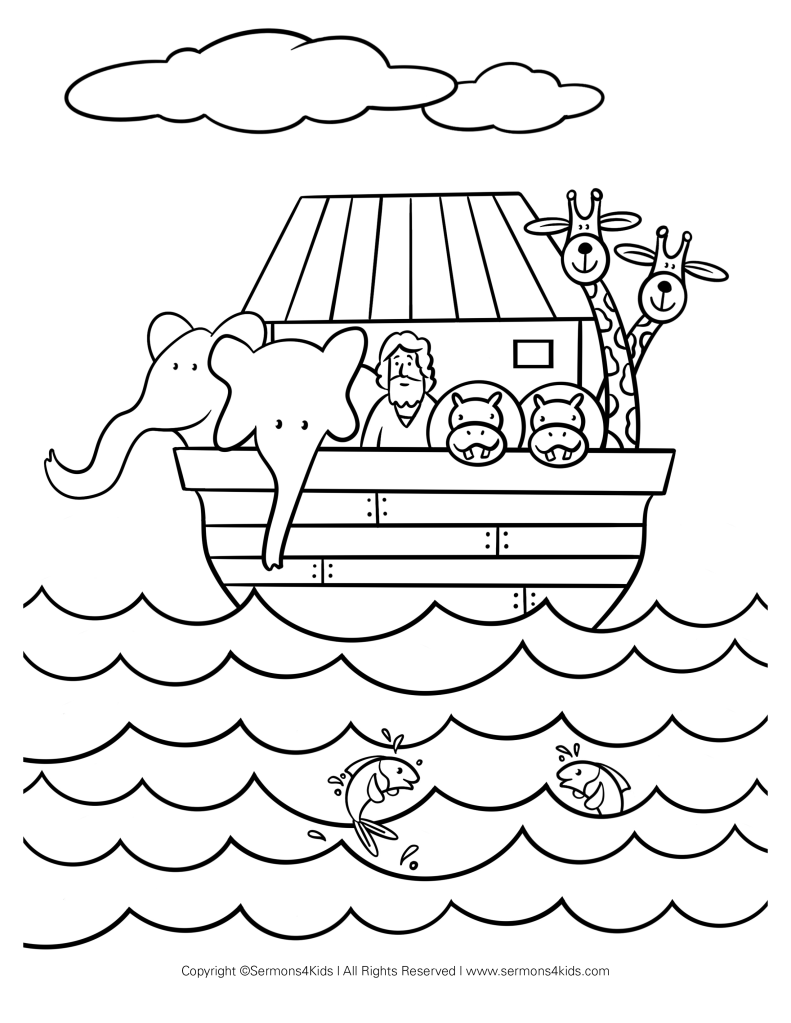
Once upon a time, there was a man named Noah.

Noah was a good and righteous man who always did what was right, and this pleased God.

However, not everyone in the world was like Noah.

One day, God looked down at the world and saw that the people were being very wicked and not taking care of the earth. God decided to do something about it.

God told Noah to build a big boat called an ark and then gather two of every kind of animal, one male and one female, to bring with them onto the ark.

God explained that he was going to send a great flood to cleanse the earth, and the ark would keep Noah, his family, and all the animals safe.

Noah and his family toiled away for many years, working really hard to build the ark.

They made sure to follow God’s instructions and made the ark very strong. They also collected enough food for themselves and the animals, which they would need during the flood.

Once the ark had been completed, Noah, his family and all the animals went inside.

As soon as Noah and his family were safely in the ark, it began to rain. And then it rained and rained for forty days and forty nights.

Eventually, the floodwater covered the entire world, but the ark floated on the water keeping everyone dry.

Being cooped up in the ark like that, it must have felt as if the rain was going to last forever, but Noah and his family trusted God. They took care of the animals and waited for the rain to stop.

After forty days, the rain did finally stop, and so Noah sent out a dove to try and find dry land. The dove quickly returned, but after seven days, the dove was sent out again. This time the dove came back with a freshly plucked olive leaf in its beak, which meant there must be dry land nearby.

Noah and his family were so happy, they knew the flood was almost over.

When God told them it was time to leave the ark, they opened the doors. Noah’s family and the animals stepped out onto dry land.

They were happy and grateful to God for saving them.

God then made a promise to Noah that He would never send such a big flood again.

As a sign of His promise, God put a beautiful rainbow in the sky. And from that day on, whenever it rains and a rainbow appears, people remember God’s love and faithfulness.
Proverbs 31:10-31

Hymn to a Good Wife

10-31 A good woman is hard to find,
    and worth far more than diamonds.
Her husband trusts her without reserve,
    and never has reason to regret it.
Never spiteful, she treats him generously
    all her life long.
She shops around for the best yarns and cottons,
    and enjoys knitting and sewing.
She’s like a trading ship that sails to faraway places
    and brings back exotic surprises.
She’s up before dawn, preparing breakfast
    for her family and organizing her day.
She looks over a field and buys it,
    then, with money she’s put aside, plants a garden.
First thing in the morning, she dresses for work,
    rolls up her sleeves, eager to get started.
She senses the worth of her work,
    is in no hurry to call it quits for the day.
She’s skilled in the crafts of home and hearth,
    diligent in homemaking.
She’s quick to assist anyone in need,
    reaches out to help the poor.
She doesn’t worry about her family when it snows;
    their winter clothes are all mended and ready to wear.
She makes her own clothing,
    and dresses in colorful linens and silks.
Her husband is greatly respected
    when he deliberates with the city fathers.
She designs gowns and sells them,
    brings the sweaters she knits to the dress shops.
Her clothes are well-made and elegant,
    and she always faces tomorrow with a smile.
When she speaks she has something worthwhile to say,
    and she always says it kindly.
She keeps an eye on everyone in her household,
    and keeps them all busy and productive.
Her children respect and bless her;
    her husband joins in with words of praise:
“Many women have done wonderful things,
    but you’ve outclassed them all!”
Charm can mislead and beauty soon fades.
    The woman to be admired and praised
    is the woman who lives in the Fear-of-God.
Give her everything she deserves!
    Adorn her life with praises!

The New has Come.

Essay by Dan

It has been my experience, while trying to wrap my mind around the old and new covenant of God, we need a global view of scripture to gain a proper understanding of both covenants. God defined the New Covenant in the Old Testament (Jeremiah 31:31-34). Later, in the New Testament, we find Jeremiah’s definition used in the Book of Hebrews (Hebrews 8:7–12). In fact, this is the longest quote from the Old Testament presented in the New Testament. Using the Hebrews passage as a template, we find three pillars for the new covenant: Reconciliation, Revelation, and Forgiveness.

Reconciliation. God says — I will put my laws in your mind and write them on your heart (Hebrews 8:7). He inserted the law into our heart to help us resist Lucifer’s influence. He removed the barrier between us and himself. Ezekiel said – God will put His Spirit within you so that you walk in His statutes, see His ordinances, and you are able to keep them (Ezekiel 36:26-27, paraphrased). Paul wrote – For anyone in Christ is a new creation; the old has gone, the new is here! All this is from God, who reconciled us to Himself through Jesus and gave us the ministry of informing the world of this reconciliation through Jesus, thereby not counting people’s sins against them anymore (2 Corinthians 5:17–21 paraphrased).

Revelation. God says — I will be your God, and you will be my people. No longer will you teach your neighbor or say to one another, ‘Know the Lord,’ because you will all know Me, from the least of you to the greatest (Hebrews 8:10-11 paraphrased). Later, Jesus specifically included the gentiles when He said – Go therefore and make disciples of all nations, baptizing them in the name of the Father and of the Son and of the Holy Spirit, teaching them to observe all that I have commanded you; and lo, I am with you always, to the close of the age (Matthew 28:19-20). It is this simple – God revealing himself to us.

Forgiveness. God says — I forgive your wickedness and remember your sins no more. God promises to forgive our sins and justify us — we stand before God as though we had never sinned (implied in Hebrews 8:12). Paul defines the impact of reconciliation and revelation when he writes – If you declare with your mouth, ‘Jesus is Lord,’ and believe in your heart that God raised him from the dead, you will be saved. For it is with your heart that you believe and are justified, and it is with your mouth that you profess your faith and are saved (Romans 10:9-10). We ask, he grants, we are recipients of his grace – we are forgiven.

These three pillars (reconciliation, revelation, and forgiveness) define the covenant path to the Kingdom. They are the principal elements of the new covenant (the Gospel). From my perspective, the new covenant is built on absolutes, hardcore assurances, a promise to us that we will be with Him forever. The mediator (Jesus) intercedes for us, averting God’s wrath for our extensive list of sins.

We stand “shaking like a leaf”, helpless before the formidable righteousness of God. The only thing that redeems us is inclusion in the new covenant by the mediator. We have not earned a seat at the table; we were granted a seat at the table. Not by what we did, but by his forgiveness and grace. We have nothing of value to offer in exchange for our life – Jesus alone offered something valuable to redeem us.

We are blessed by the Father, reconciled through the sacrifice of Jesus, we are blessed by the redemptive power of the blood of Jesus (just as the Hebrew children were redeemed by blood from the Passover lamb eons ago). Finally, we are blessed by revelation from the Holy Spirit, freely extending His insight (teaching) to us about the things of God. Just as the Hebrews saw the power of God through the daily allocation of manna, we obtain our daily bread (teaching) in scripture. We have nothing to offer, we are unworthy to receive this grace. We are granted grace as an expression of unconditional love. Selah.

I choose Jesus.

Finding the Eye of God

Essay by Dan

It has been my observation that Jeremiah says the more we seek God, the more we are going to experience His presence in our lives. You will seek Me and find Me when you seek Me with all your heart. (Jeremiah 29:13). Without faith it is impossible to please God because anyone who comes to Him must believe that He exists and that He rewards those who earnestly seek Him. (Hebrews 11:6)

Furthermore, God is hunting for willing hearts, over and over, every day he looks, his eye moves to and fro — “The LORD looks down from heaven on all mankind to see if there are any who understand, any who seek God.” (Psalms 14:2). We are never far from his gaze… The counterpoint? Our lives are full of activities, stuff, and people competing for our attention. The distractions are just part of everyday life, so we often do not notice them until the damage is done.

Getting too busy, my day starts quickly, I race from one thing to the next without pausing. I fall into bed intending to read the Bible or pray, only to fall asleep exhausted. Not only do I fill my schedule, but I also fill my mind. With technology at our fingertips, we may try to fill every spare minute with entertainment or information. Television, movies, music, games, and social media all use energy. Some activities have a positive effect on me; many events do not. Regardless, God’s voice is competing with them for my attention. Despite my foolishness, he pursues me.

Yet, my choices can drown out God’s voice. My attitudes and habits can lead me away from Him without realizing it. Once questionable behaviors become a pattern, the pattern starts directing choices. Poor decisions are covered with shame, those decisions make me want to hide in the shadows from God. Sweet Jesus, how do I break this pattern?

Many people do not realize that doing nothing (apathy) keeps us from hearing God’s voice too. Apathy, a lack of concern or interest, toward the things of God can be just as detrimental to your relationship with Him as implementing poor behavior patterns because you are focused on earthly things. The voice of God always says something that reflects His character. God is gracious, kind and patient. He pursues me; then He installs peace and unity into my life. The more space I give to attitudes that are opposed to God’s qualities, the less I am willing to hear whatever He is trying to tell me.

JI Packer teaches us – The Spirit leads by helping us understand the biblical guidelines within which we must keep, the biblical goals at which we must aim, and the biblical models that we should imitate, as well as the bad examples from which we are meant to take warning. He leads through prayer and others’ advice, giving us wisdom as to how we can best follow biblical teaching. He leads by giving us the desire for spiritual growth and God’s glory. The result? Spiritual priorities become clear; our wisdom when making decisions is increased. He will cause us to delight in His will so that we find ourselves wanting to do it because we know it is best. Wisdom’s path will be ‘ways of pleasantness’ (implied in Proverbs 3:17).

The deeper truth — God is not devious; He does not push us to watch our suffering. If our first reaction is to resist God’s will, He will gently change our attitude — if we let him. God wants the absolute best for us in every activity he designs for us, even activities we shrink from or activities that may involve unpleasantness. In His time, His peace always arrives. Yield, call out for his help.

He who is drifting from the Logos — yield to the Ayin Adonai (Proverbs 15:3), find your bible, and start reading. Find God’s wisdom and affection. The Eye of the Lord (Ayin Adonai) is ready to help. There are no secrets, He knows. Read, learn, seek out Jehovah Shalom. Call out, be still, He is on the way.

I choose Jesus.

Never Let It End, God

Ruth Graham

Never let it end, God,
never–please–
all this growing loveliness,
all of these
brief moments of
fresh pleasure–
never let it end.
Let us always
be a little
breathless at love’s beauty;
never let us
pause to reason
from a sense of duty;
never let us
stop to measure
just how much to give;
never let us
stoop to weigh love;
let us live–
and live!
Please, God,
let our hearts kneel always,
Love their only master,
knowing the warm impulsiveness
of shattered alabaster:*
I know You can see things
the way a new bride sees,
so
never let it end, God,
never–please.