
Month: September 2024
Holy, Holy, Holy
“Holy, holy, holy! Lord God Almighty!
Early in the morning our song shall rise to Thee;
Holy, holy, holy, merciful and mighty!
God in three Persons, blessed Trinity!
Holy, holy, holy! All the saints adore Thee,
Casting down their golden crowns around the glassy sea;
Cherubim and seraphim falling down before Thee,
Who was, and is, and evermore shall be.
Holy, holy, holy! Though the darkness hide Thee,
Though the eye of sinful man Thy glory may not see;
Only Thou art holy; there is none beside Thee,
Perfect in pow’r, in love, and purity.
Holy, holy, holy! Lord God Almighty!
All Thy works shall praise Thy Name, in earth, and sky, and sea;
Holy, holy, holy; merciful and mighty!
God in three Persons, blessed Trinity!”
John Bacchus Dykes was an English clergyman and hymnwriter.
Parable of a Good Samaritan
Wherever Jesus went people would come to hear him tell about God. They loved to hear him tell parables. Parables were stories that helped people understand important lessons.
Once a man who was an expert in the Law of God asked Jesus a question, “Teacher, what must I do to live forever?”
Jesus knew that man was an expert in God’s Old Testament Laws. He asked the man what the Old Testament Law said that a person must do to live forever.
The man’s answer was, “Love the Lord your God with all your heart and with all your soul and with all your strength and with all your mind, and, Love your neighbor as yourself.”
Jesus told the man that he was right. That was the greatest commandment. That is the way to live forever.
Then the man asked about loving your neighbor as yourself. Did he have to love all his neighbors or just the ones that lived close by? He asked Jesus, “Who is my neighbor?”
Instead of telling him the answer Jesus told a parable. This is the parable:
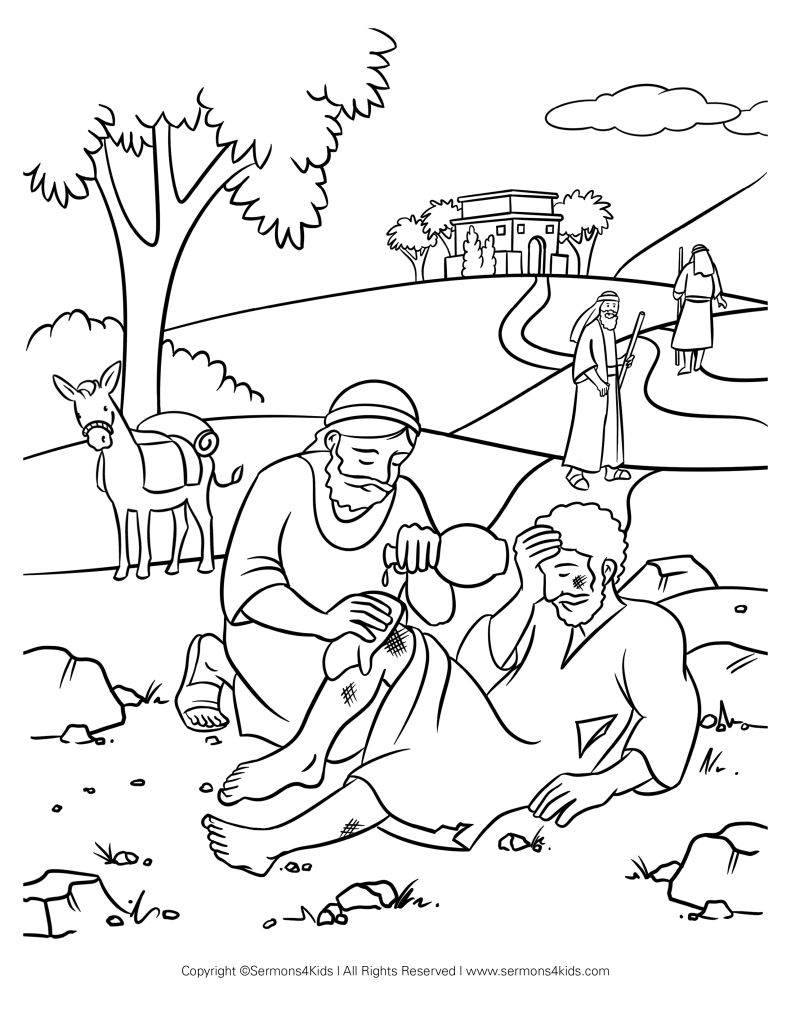
A man was travelling by himself from Jerusalem to the town of Jericho. While he was on the road some robbers attacked him. They beat him up and took everything he had – even his clothes! The man was left all alone on the road. He waited and waited for someone to come by and help him.
A priest came walking by on the road. Priests were God’s helpers in the temple. They knew how to worship God. They knew all of the rules of God. Do you think the priest helped the man? No, the priest went to the other side of the road and passed right by the man without help.
Next, a Levite came along the road. Levites knew all of God’s laws. They were good Jews. Do you think the Levite stopped and helped the man? No, the Levite looked at the man and then crossed the road and walked right past him.
Finally, a man from Samaria came along the road. The Jews did not like Samaritans. Everybody thought that the Samaritans would never help anybody. But this Samaritan was good. He saw the man on the road, and he stopped to help. He put oil and wine on the man’s wounds. (Oil and wine were used for medicine in those times.) Then he lifted the man onto his donkey and took him to a nearby inn. He took care of the man all night to make sure he was going to be well.
The next morning the Samaritan had to leave to continue his journey. He wanted to make sure that the injured man was taken care of, so he gave money to the innkeeper. He gave him enough money so that the man could stay at the inn for two months! He even told the innkeeper that he would come back the next time he was travelling and pay more money if the man was still sick.
Everyone was very surprised to hear this parable. When Jesus was finished, he asked the expert in the Law of God a question, “Three men went on the road that day: the priest, the Levite and the Samaritan. Which of these men do you think was a neighbor to the man who was beaten and robbed?”
What do you think the expert in the Law of God answered? That’s right, the Samaritan was a neighbor. Helping anyone who needs help is being the kind of neighbor that God wants. We don’t even have to know the person. We should help them just because they need help.
Scripture Reference: Luke 10:25-37
Psalms 90:10-17
The Message
3-11 So don’t return us to mud, saying,
“Back to where you came from!”
Patience! You’ve got all the time in the world—whether
a thousand years or a day, it’s all the same to you.
Are we no more to you than a wispy dream,
no more than a blade of grass
That springs up gloriously with the rising sun
and is cut down without a second thought?
Your anger is far and away too much for us;
we’re at the end of our rope.
You keep track of all our sins; every misdeed
since we were children is entered in your books.
All we can remember is that frown on your face.
Is that all we’re ever going to get?
We live for seventy years or so
(with luck we might make it to eighty),
And what do we have to show for it? Trouble.
Toil and trouble and a marker in the graveyard.
Who can make sense of such rage,
such anger against the very ones who fear you?
12-17 Oh! Teach us to live well!
Teach us to live wisely and well!
Come back, God—how long do we have to wait?—
and treat your servants with kindness for a change.
Surprise us with love at daybreak;
then we’ll skip and dance all the day long.
Make up for the bad times with some good times;
we’ve seen enough evil to last a lifetime.
Let your servants see what you’re best at—
the ways you rule and bless your children.
And let the loveliness of our Lord, our God, rest on us,
confirming the work that we do.
Oh, yes. Affirm the work that we do!
Finding the Path Home
Essay By Dan
It has been my observation from Genesis 3 that we have been rebellious since the beginning. The rebellion started with Adam and expanded to all of us. Then Elohim (God) pushed the reset button on civilization (Noah and the flood) and started fresh with one family. Gradually, after the flood, Elohim introduced rules to live by (Leviticus) – a process of self-regulation that required our attention.
When I read Leviticus, I am struck by the sheer volume and range of trouble we can get ourselves into. Human sin is very destructive. It disfigures our soul, pollutes our mind, and taints our heart with darkness. God’s work in us is impaired, distracted, weakened. Our relationships are fractured, we struggle for power, we become aggressive in our heart, and eventually we become comfortable with evil. Rebellion and self-aggrandizement become our highway to mediocracy. Our sin is invasive; it spreads from our heart to our family – then the rebellion quickly infects the community and creeps into God’s house. The Holy of Holies becomes unclean. How does God feel? I suspect a combination of exasperation and compassion for us. We vandalize his house with our sin, leaving our tags everywhere. His tears form. We leave our trash in heaps at his feet (as we unburden ourselves) and then head straight back into the cesspool. He sighs. He is holy, we are mired in rebellion. Yes, I too am guilty of creating trash heaps.
The ancient story of Israel and Egypt is a story of sorrow when God’s people choose to take ownership of God’s plan and redefine morality to suit their desires. As a result, they became slaves in Egypt. Enter Moses, the Red Sea, the Tabernacle, and the book of Leviticus. Tabernacle operations (defined in Leviticus) was the method where God opened the door to dwell amongst the people with a new leadership plan (sin payments). The tabernacle walls protected our eyes from Elohim’s shekinah light.
You know that sin is infectious. It is easier to continue than stop. The Israelites needed a path that pulled them away from sin, cleared the debt of sin, and opened the door to sustainable operations in God’s presence. This leads us to the reason for animal sacrifice. The sacrifice was first seen in the skins provided by God to Adam and Eve to cover their nakedness (self-awareness of sin); then, as time progressed, sin became much more deplorable. Rampant sin illustrated the need for a new covenant.
I would not find it easy to cut an animal’s throat and watch it die, even if it were necessary to rectify my personal foolishness. Please understand, I am a carnivorous person, killing animals is part of that lifestyle. But this sacrifice thing is different. Watching life (blood) drain into a bowl, a visceral image of the outcome of sin, would be an overwhelming event for me. We (through our sin) accelerate the darkness that tries to crush the world. The impact cannot be overstated; it may not seem like much to yell at your neighbor. Who gets injured? Yet, looking at sin on the global scale, the multiplication factor drives the number of sins towards infinity every moment of every day. The aggregate of our sin grieves God. The old covenant law exposes Lucifer and our weakness. The new covenant is built on grace.
The symbolism of the sacrifice is a physical expression of God’s demand for justice and desire to offer grace. Elohim is justified when he wants people to face the consequences (owning the sacrifice). But, at the same time, he feels compassion for us. So, he accepts the animal’s life as a temporary payment. Consider the impact of the Yom Kippur’s blood offering and the scapegoat (sin removal). This is a precursor for the ransom of Jesus and the Holy Spirit to write Elohim’s precepts on our hearts.
John wrote — God showed his love among us: He sent his one and only son into the world that we might live through him. This is love: not that we loved God, but that HE LOVED US and sent his Son as an atoning sacrifice for our sins. (1 John 4:9-10). His love and sacrifice for us defines our path home.
I choose Jesus.
Deuteronomy

The Freedom to Give
Essay By Dan
It was my observation while making a survey of Leviticus that Elohim set up a series of rules for the application of sacrifice to address the commission of sin. What I found interesting was the list of problems that require a sacrifice served as a roadmap for Lucifer’s sphere of operations. God chose to define the areas Lucifer uses to draw us into a state of rebellion. God then conveniently provides a path back from each operational area used by Lucifer. The more we understand about Lucifer’s sphere of operation the less effective Lucifer is trying to dismantle our relationship with the one true living God.
Consider the implication of the sacrificial guidelines (see Leviticus 16). The animal being offered had to be perfect. There needed to be a connection between the animal and the person offering the animal for sacrifice. The person offering the animal had to be part of the death process (direct kill or a sanctioned kill by a priest). The person offering the animal knows the sacrifice is only a temporary cover for sin. I think this lays the framework for the death, burial, and resurrection of our perfect ransom — Jesus.
Once per year, the Day of Atonement (Yom Kippur) provides full forgiveness and sin removal at the national level for the Israelites. The high priest presented two male goats; one for a sin offering and the other was released into the wilderness as a scapegoat. The sin offering incurred God’s forgiveness; the released goat provided removal of sin. Humm… Sound a bit familiar?
Jesus functioned as the sin offering (similar to the Yom Kippur). The Yom Kippur scapegoat carried the sins of the people into the desert to be lost for all time. The impact? Our sin is forgotten. I think it is reasonable to view the sacrifice of Jesus as a perfect version of the Yom Kippur. Peter tells us that Jesus carried our sin in his body (implied in 1 Peter 2:24); the author of Hebrews tells us the sacrifice of Jesus caused the permanent removal of our sin (implied in Hebrews 9:8-14).
Let us dig a little more. When I read Exodus, Leviticus, or Numbers; I note a plethora of verses on sacrificial operations. We cannot help but notice the group of people selected to be priests (Hebrew term — Kohanim) during the exodus from Egypt. They were the only ones who were allowed to accomplish the sacrifices and bring the nation closer to God. Aaron was the first priest (Hebrew term — Kohen), gradually his male children became the group of priests (Kohanim) who managed the temple. The Kohanim (priests) were required to clear their own sin first, then they were able to address the sin of individuals, or even the entire nation (Yom Kippur).
The sacrifices offered by the Kohanim (priests) were called Korban (Hebrew term for sacrifice). The Korban was presented in the temple at least three times a day. The Korban (often translated sacrifice) means ‘draws close.’ There were three types of korbans – animal sacrifice, grain offering, and money donations. The desired effect of the Korban was to prepare a path for God to dwell amongst us on a daily basis (Exodus 25:8). The Korban was a constant reminder to us of the areas where Lucifer would attack — his modus operandi. If we want to know how he will move against us (sphere of operation) then we should get familiar with the law. Lucifer’s battle plan is very clearly presented in the law.
The deeper truth – the Korban, in its purest form, brings us closer to God. Jesus chose to offer himself for us as the ultimate Korban. Unlike the animals who do not have a say in their role as the Korban, Jesus offered himself with no pressure from Elohim. Jesus said — Just as the Father knows me, and I know the Father— I LAY DOWN MY LIFE FOR THE SHEEP (John 10:15 paraphrased). He chose to be the sacrifice. Jesus freely gave his life for us. His offering was far better than the Old Testament Korban. His ransom payment was a permanent response for our sin.
I choose Jesus.
 Shalom Talk