
Month: September 2024
Praise to the Lord, the Almighty
“Praise to the Lord, the Almighty,
the King of creation!
O my soul, praise Him, for He is thy
health and salvation!
All ye who hear,
Now to His temple draw near;
Sing now in glad adoration!
Praise to the Lord, who o’er all
things so wondrously reigneth,
Who, as on wings of an eagle,
uplifteth, sustaineth.
Hast thou not seen
How thy desires all have been
Granted in what He ordaineth?
Praise to the Lord, who hath fearfully,
wondrously, made thee!
Health hath vouchsafed and, when
heedlessly falling, hath stayed thee.
What need or grief
Ever hath failed of relief?
Wings of His mercy did shade thee.
Praise to the Lord, who doth prosper
thy work and defend thee,
Who from the heavens the streams of
His mercy doth send thee.
Ponder anew
What the Almighty can do,
Who with His love doth befriend thee.
Praise to the Lord! Oh, let all that
is in me adore Him!
All that hath life and breath, come
now with praises before Him!
Let the Amen
Sound from His people again;
Gladly for aye we adore Him.”
Joachim Neander (1650 – 31 May 1680) was a teacher, theologian and hymnwriter whose most famous hymn, Praise to the Lord, the Almighty, the King of Creation has been described by John Julian in his A Dictionary of Hymnology as “a magnificent hymn of praise to God, perhaps the finest creation of its author, and of the first rank in its class.
Jesus Teaches About Salt and Light
Many, many people wanted to hear Jesus speak. He went to the side of a hill and sat down so that everyone could gather around and listen. Then he began to tell them how they could follow God. He told them about heaven. He told them they should be kind to other people even if other people were not kind to them. He told them that they should help poor people and that they should not judge others.
To help people understand something very important, Jesus told them a parable.
Jesus looked at the people and said, “You are the salt of the earth. But if salt loses its saltiness, how can it be made salty again? It is no longer good for anything, except to be thrown out and trampled by men.”
What do you think Jesus meant? Do you think he was saying that we are not human, but we are salt instead? Of course not. Jesus was saying something very important, but he was trying to make it simple to understand. He was using the example of salt.
Do you like salt? What does food taste like when there is no salt in it? When salt is added to some foods they taste much better. God put Christians in this world so that we can make the world better. Are you salt? Do you make this world better?
After Jesus told the people the parable about the salt he told them another parable.
Jesus said, “You are the light of the world. A city on a hill cannot be hidden. Neither do people light a lamp and put it under a bowl. Instead, they put it on its stand, and it gives light to everyone in the house. In the same way, let your light shine before men, that they may see your good deeds and praise your Father in heaven.”
What do you think Jesus meant when he said: “You are the light of the world”? Did he mean we are not human but that we are light bulbs? Of course not. He was saying a parable to tell the people something very important.
Many people in this world do not know about God. Jesus said that it is like they are in a very dark place. They need someone to give them some light so that they can see. When Christians obey God then it is like a light is shining. People see Christians doing good things and it makes them want to follow God.
If we do good things, it is like our light is shining. If people never see us do or say good things, then it is like we are putting a big bowl over our light. No one can see a light under a bowl.
Sometimes we get embarrassed or shamed and we don’t want people to know that we are Christians. Has that ever happened to you? If we are ashamed to do good things, then it is like putting our light under a bowl.
How many of you are going to let your light shine this week?
Scripture Reference: Matthew 5:13-16

Ecclesiastes 9:10
The Message
7-10 Seize life! Eat bread with gusto,
Drink wine with a robust heart.
Oh yes—God takes pleasure in your pleasure!
Dress festively every morning.
Don’t skimp on colors and scarves.
Relish life with the spouse you love
Each and every day of your precarious life.
Each day is God’s gift. It’s all you get in exchange
For the hard work of staying alive.
Make the most of each one!
Whatever turns up, grab it and do it. And heartily!
This is your last and only chance at it,
For there’s neither work to do nor thoughts to think
In the company of the dead, where you’re most certainly headed.
Writing Love in Our Heart
Essay By Dan
It was my observation while learning about the mediator function held by Jesus that I was not very knowledgeable about the origins of sacrifice as defined by scripture. I followed this tangent and started learning. In the book of Leviticus, the Israelites were instructed by God on the topic of sacrifice. In my view, the notion of sacrifice is a God directed process where blessings are appropriated through the offering of a specified element for a specified sin. But I must be clear – the sacrifice begins and ends with God. In His kindness, He provides this avenue to his people so that they, by faith, might receive grace.
When I looked for the first sacrifice, I noted that God covered Adam and Eve with animal skins. These animals were used (sacrificed) to address Adam and Eve’s rebellion (Genesis 3:21). This event was not specifically called a sacrifice, but the metaphor is clear. Their sin (rebellion) was covered (literally with skins) by the death (shed blood) of another being. Their anxiety was relieved, and they were willing to talk with God once the coverings were in place. The next sacrifice occurs when Abel offers a sacrificial animal (firstling) as gratitude for a good year of crops (Genesis 4:3-5). I should mention — Abel’s attitude was correct, the sacrifice was effective; Cain’s attitude was incorrect, his sacrifice was not accepted.
The Lord said to Moses in Leviticus 17:3-7 (paraphrased) — Any Israelite who offers a sacrifice in the camp or outside of it instead of bringing it to the tabernacle of the Lord—that person shall be considered guilty of bloodshed. This is so the Israelites will bring to the Lord the sacrifices they are now making in the open fields. They must bring them to the Lord and sacrifice them as fellowship offerings. The priest is to splash the blood against the altar of the Lord and burn the fat as an aroma pleasing to the Lord. They must no longer offer any sacrifices to their idols. (NIV).
Then we read in Leviticus 17:11 why the sacrifice and more specifically why the blood is important. We read — For the life of the flesh is in the blood, and I have given it for you on the altar to make atonement for your souls, for it is the blood that makes atonement by the life (ESV).
In this verse, I noted the life of the flesh is in the blood. The essential life of all beings is contained in their blood. To touch the blood is to touch life. Blood moves us from the abstract idea of life to a visual, tactile presentation of life. If there is no blood in the sacrifice, then sin remains. A life un-ransomed is no life. Not only do we need blood to live, but God also conveys eternal life to us through sacrificial blood. Let us take a deeper look by examining two key phrases in the verse.
On the Altar. The altar starts with death (the sacrifice) but quickly transitions to life. Blood is placed on the altar; when they connect (the blood and altar) then the offering becomes holy (see Exodus 29:37) and imparts life (forgiveness) to the offeror (the person bringing a sacrifice to the altar).
To make atonement for your souls. We have established that blood imparts life to sinners. Blood on the altar eradicates sin, reverses death sentences, and brings us closer to God. This begins with the death of the offering but is made complete when the blood is placed on the altar.
The deeper truth — The blood offering was much more substantial than the rest of the offering. No part of the offering was transported into the holy of holies except for the blood. Without the blood, there was no forgiveness (Hebrews 9:22). In the old covenant, blood covered our sin in much the same way that the skins covered Adam and Eve – yet their heart remained corrupted. In the new covenant the blood of Jesus paid our ransom completely – our heart is changed. His life was in that blood – His life changed us. His blood was offered in our stead – we are transformed. The Spirit writes love in our heart.
I choose Jesus.
Psalms 55
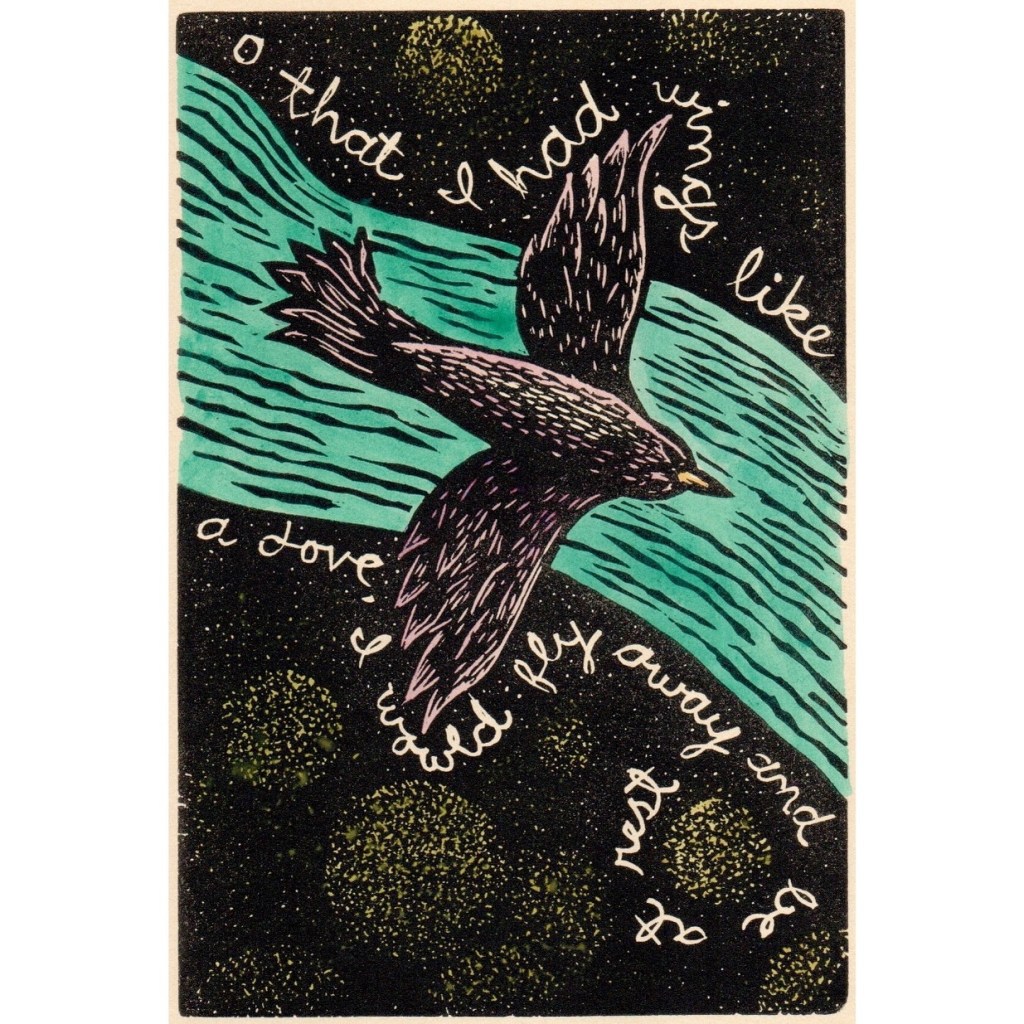
In these our days of turmoil,
of restlessness and complaint,
we accuse and betray one another,
lashing out in the fury of pain.
We set on one another with greed,
we persecute with baying and clamour.
We see slaughter and our hearts writhe,
the horrors of dying overwhelm us.
Violence reigns in the streets of the city,
vicious dogs snarl at the stranger.
Fraud flits through the market place,
greed wins softly behind baize doors.
My eyes flash wild with horror,
my limbs quake and I cannot still them.
My heart grows cold through fear,
the ice of death grips me.
I said. O for the wings of a dove,
that I might fly away and be at rest.
I yearn to flee to the mountains,
to make my dwelling in the wilderness. . .
I cast my burden on you, O God,
and you will sustain and encourage me.
I will call from the midst of my groaning,
you will redeem me to healing and peace. . .
Your arms are wide and welcoming,
in your presence we are relaxed,
and feel most strangely at home.
~ Jim Cotter, based on Psalm 55
————-
Listening Lord,
listen now.
Speaking God,
speak to me now.
I am crushed by fear,
weighed down with worry,
with no sign of relief in sight.
I am heart-sick;
death-dreading;
flung into a nightmare world.
Hunted.
Hounded.
Lost in a labyrinth of death.
If I could fly away, Lord;
make for the skies like a bird;
I’d be off in a moment—
off to some far-flung Heaven
beyond the reach of this hell.
Here I am,
dreaming of escape
while cities burn;
the innocent suffer;
as evil spins its web
around the world—
an encircling darkness;
a pall over every living thing. . .
In distress,
I open my heart to You, Lord.
I pour out its treasure
into Your open hands—
until fear subsides
and my spirit rests.
I take comfort in the knowledge
that this suffering will one day end;
that evil will not have the final word.
Come quickly, Lord Jesus.
All my hope is in You.
~ Smith & Wilt, based on Psalm 55
Art of Kreg Yingst
The Deal is Off!
Essay By Dan
It has been my observation while reading the Book of Hebrews, the author has gone to great lengths to relate the importance of the last supper to the old and new covenant. Now let us couple the message from the Book of Hebrews on the covenant with events that occurred during the Last Supper. We see in Matthew and Luke that Jesus explained to the disciples why He was going to be nailed to a cross. During that discussion, He took them right to the blood of the covenant and its purpose therein.
In Matthew we read – “While they were eating, Jesus took bread, he broke it, and gave it to his disciples, saying, ‘Take and eat; this is my body.’ Then he took a cup and he gave it to them, saying, ‘Drink from it, all of you. This is my blood of the covenant, which is poured out for many for the forgiveness of sins. I tell you; I will not drink from this fruit of the vine until that day when I drink it new with you in my Father’s kingdom.’ ” (Matthew 26:26-29 paraphrased)
At the Last Supper, Jesus carefully explains the spilling of his blood initiates the new covenant (atoning ransom sacrifice for our sins), this ransom message is noticeably clear in Matthew. Jesus presents himself as both the high priest (mediator) offering the sacrifice and the sacrifice himself.
In Luke, we read — After taking the cup, he said, “Take this and divide it among you. For I tell you I will not drink again from the fruit of the vine until the kingdom of God comes.” And he took bread, gave thanks, broke it, and gave it to them, saying, — This is my body given for you; do this in remembrance of me. This cup is the new covenant in my blood, which is poured out for you (Luke 22: 17-20 paraphrased).
Every time we partake in Communion, we hear the message specifying why we take the cup: “This cup is the new covenant in My blood which is poured out for you for the forgiveness of sins” You are hearing the explanation from Jesus of why He had to die. Communion is part of the definition for a new covenant with God, you violated the old covenant, you deserve to die. Jesus made a new deal for us. Jesus implies — I spoke to my Father, I am going to die (ransom sacrifice) in your place, then my Father will be glorified, and my followers will be redeemed forever.
When I ponder on the implications of communion, I think that Jesus is saying — every time you come to that table, I want you to remember that you are in fellowship with My Father, not because of anything that you have done, but because of what I have done. I died in your place to fulfill the curses that should have fallen on your head. I died the death of a covenant-breaker, even though I was the one who was faithful to the covenant so that all you covenant-breakers who believe on Me, who trust in Me, who have faith in Me alone for your salvation, might come into fellowship, reconciled with God.
Final thoughts – the author of Hebrews is encouraging his Jewish readers to not look back to the old covenant rituals as their way into fellowship with God. The old rituals mean nothing apart from Jesus. Do not look at your works, your service, your status, your reputation, your church job title; do not look at anything but Jesus for your reconciliation with God. Why? If we distance ourselves from the ransom and resurrection of Jesus, inserting our works as proof of worthiness into the formula, there is no reconciliation. The deal is off – the impact of the new covenant has been rendered impotent by our feeble proof!
I choose Jesus.
 Shalom Talk