

Faith
Written By Dan
It was my observation while reading Deuteronomy that we are instructed to Love the Lord our God with all our heart and with all our soul and with all our strength and with all our mind (Deuteronomy 6:5). Additionally, I noted considerable New Testament guidance on how to wrap your heart around God.
For example — Show earnestness in realizing the full assurance of hope to the end (Hebrews 6:11); Love one another earnestly from the heart (1 Peter 1:22); Strive to enter by the narrow gate (Luke 13:24); Labor for the food that endures to eternal life (John 6:27); Be steadfast, immovable, always abounding in the word of the Lord (1 Corinthians 15:58); Let us not be weary in well-doing, for we shall reap if we do not faint (Ephesians 5:15); and Work out your own salvation with fear and trembling (Philippians 2:12).
Additionally, Titus 2: 11-15 says — For the grace of God has appeared that offers salvation to all people. It teaches us to say “No” to ungodliness and worldly passions, and to live self-controlled, upright and godly lives in this present age, while we wait for the blessed hope—the appearing of the glory of our great God and Savior, Jesus Christ, who gave himself for us to redeem us from all wickedness and to purify for himself a people that are his very own, eager to do what is good. These, then, are the things you should teach. Encourage and rebuke with all authority. Do not let anyone despise you. (NIV)
How do we respond to this extensive set of guidelines from Scripture? We strive to be like Jesus. We labor to find his pace, his stride. We abound in hunger for scripture. We become zealous and earnest for the peace of God. We find the path away from laziness and lukewarmness. We take to the run, with the stride and confidence held by a winner. Jesus makes us a winner. For Jesus has placed this mantle of strength upon us to operate in this world but not be corrupted by this world. We immerse ourselves in the strength he supplies to magnify His glory.
So, what do we do? I think we are to lay aside the heavy load upon our backs, the sin of this world that surrounds and covers us like a heavy scratchy wool blanket. An experienced runners discards everything but what is necessary; this is also true for spiritual racing. Then we find our stride and enter the race. We run the race with patience and endurance. To run this race, I work to lay aside all the things that hinder me, that nip at my heals, I bring plans to guide my feet. The obstacles are there to keep me from being the man that God called me to be. The obstacles are there to neuter the calling I received from God. Then I need to bring up the more slippery obstacles. Paul referred to them as disputable issues.
Romans 14:1-4 says — Accept the one whose faith is weak, without quarreling over disputable matters. One person’s faith allows them to eat anything, but another, whose faith is weak, eats only vegetables. The one who eats everything must not treat with contempt the one who does not, and the one who does not eat everything must not judge the one who does, for God has accepted them. Who are you to judge someone else’s servant? To their own master, servants stand or fall. And they will stand, for the Lord is able to make them stand.
There will be things that people, convinced they know best, will impose on others, using vague scripture to make their case. We must be careful not to become entwined in disputes over vague issues. They are nothing more than speedbumps. Nothing more than obstacles to the plan.
I choose Jesus.
Jesus told a parable about a man with two sons. A parable is a simple story to help people understand something hard to understand – something that is important to understand.
In this parable, a man had two sons. The father knew that someday he would get very old and die. When he died, all his money, house, and farm would be given to his two sons. The money and property that children receive from someone who dies is called an “inheritance”.
The younger son was very impatient. He did not want to wait for his father to die to get his inheritance. He wanted his father’s money soon so he could go and spend it. He asked his father to divide the money and give him his part. The father wanted his son to be happy, so he did as his son asked. He divided the money and gave half to his youngest son.
The younger son took all the money and left home. He went to live in another country that was very far from his home. He bought everything that he wanted. He spent money on parties and wasteful things. People liked him because he had lots of money and bought things for them.
The problem was that soon the money ran out. He had no more money for parties, and his friends stopped liking him. It turns out that they weren’t real friends after all. They only liked him when he bought them things. Now that he had no money, they did not even want to be around him.
Soon, the younger son ran out of food and became very hungry. He had to think of a way to earn money, or he would starve!
The situation became even more serious because there was a famine in the country where the son lived. That meant that there was hardly any food for anyone to eat. Many other people were hungry. too
A farmer who owned pigs needed a helper, so the son began to work for the farmer. His job was to feed the pigs. The son was so hungry that even the pig food started to look good to him.
Finally, the son began to think about his bad choices. He thought about his father and brother. At home, people loved him. At home, there was plenty of food.
The son began to realize that he had made a terrible mistake. He should never have asked his father to give him the money early. He should have been patient. If only he could go back in time and be a good son.
“But it is too late now,” he thought. “I have done many bad things. I am not good enough to be a son now. My father would never forgive me and take me back.”
But the son had another idea. His father had many workers and many jobs to do. They worked hard but at least they had enough food. If he asked his father nicely, then maybe his father would allow him to be one of the workers. He could take care of the animals and work hard.
So, the son decided to return home.
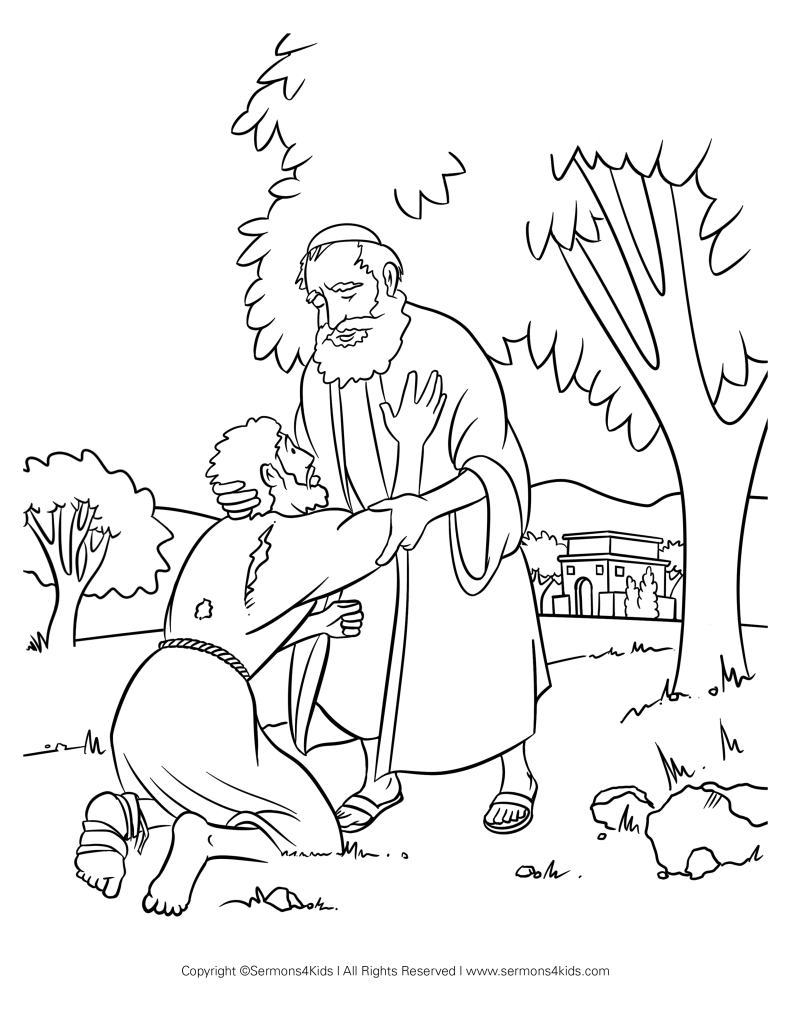
The son thought the father would be angry, but as he got closer to his old home, he was shocked to see his father running to meet him.
When the father saw his son coming, he was filled with love for him. He was so happy to see his son that he threw his arms around him and gave him a big hug and a kiss. “My son has returned to me!” his father cried.
The son said, “I am sorry, but I have done terrible things. I do not deserve to be your son. I can just be one of your workers.”
But the father did not treat him like a servant at all. He welcomed him home as his son. He told the servants to cook a big dinner. He put a beautiful robe on his son. He put a ring on his finger and special sandals on his feet.
“I thought my son was dead, and I would never see him again. But my son has come back to me!” the father said. “He was lost, but now he is found.”
The father had a special meal prepared, and everyone in the household celebrated.
Almost everyone, that is. When the older son saw everyone celebrating, he became jealous and very unhappy. “This is not fair,” he thought. “I have been the good son all along, but I am not getting the attention. I never left home and spent all the money, but nobody is having a party for me.”
But the father went to the older son and told him he loved him too. He explained to the son why he was so happy. “Don’t you understand, son? I am so happy because I thought my son was dead, but now I know he is alive!”
“He came back to me. He was lost, but now he is found!” he continued, “Please, let’s celebrate together.”
Jesus told this parable so that people would understand something about God. Sometimes we are like the young son in the parable. We do wrong things. We start to feel very bad. We might think that God would never forgive us.
But God does forgive us! When we tell God we are sorry, he is so happy. He is happy because he loves us and always wants us to do the right thing.
Do you think God will love you and forgive you if you tell him you are sorry for something?
Scripture Reference: Luke 15:11-32
Since an overseer is entrusted with God’s work, he must be blameless — not overbearing, not quick-tempered, not given to drunkenness, not violent, not pursuing dishonest gain. Rather he must be hospitable, one who loves what is good, who is self-controlled, upright, holy and disciplined. He must hold firmly to the trustworthy message as it has been taught, so that he can encourage others by sound doctrine and refute those who oppose it.
Written By Dan
It has been my observation that all of us who trust in God can always have confidence in the one true living God. In Psalms 97 we find a God of power and dignity. A God that delivers his people from troubles. We find the author of our salvation. For me, I see a God who reached into my dismal shell of a life and renewed his grace within me. Let us take a look at the details.
Psalm 97:1-7 says — The Lord reigns, let the earth be glad; let the distant shores rejoice. Clouds and thick darkness surround him; righteousness and justice are the foundation of his throne. Fire goes before him and consumes his foes on every side. His lightning lights up the world; the earth sees and trembles. The mountains melt like wax before the Lord of all the earth. The heavens proclaim his righteousness, and all people see his glory. All who worship images are put to shame (NIV).
When I had nearly given up hope of ever being ‘in service of the King’ again, he reached out to me, a person whose life was the definition of a rebel. He called me back. There was no place for me to look for salvation except in the grace of Jesus, nothing else has any value. I tried. There was nothing. I looked in philosophy, I looked in history, I looked in science, I looked in Math, nothing. There is nothing else but Jesus. There is no other name on the face of the earth that can bring us hope. None.
For the Hebrew nation and for me Psalms 97 speaks about Jesus, the author of our salvation. Our salvation is assured by God’s power, it is treasured and delivered in God’s grace, it is guaranteed to be secure, permanent, authoritative. We are saved by his strong tower, we are enabled to run the race, we are permitted to take shelter in the tower, we are safe. If I look beyond this deliverance, from my life as a rebel to the deeper things of the Spirit, I quickly notice the messianic salvation, my everlasting ransom, the repair of my soul, my rescue from death. and the restoration of my walk in Jesus.
This I know for sure — there is a world without end; and it will be well or ill with us according to our willingness to embrace the Grace of God. Plato had a feeling for this ‘world that does not end,’ but he did not find an answer to the question – is it real? Plato died when Alexander the Great was a child, Alexander the Great conquered Israel on his way south to conquer Egypt and build the city of Alexandria, soon the libraries he established became the global home of most knowledge known to man.
There are many historians that think the Septuagint (Greek Old Testament) was retained in the Alexandrian library. Why does this matter? Because this library was a repository of known knowledge. This library would have provided an answer to Plato’s question, he was curious, but he died before the library was completed. Do not wait – God’s word is readily available. Read. Now. Not tomorrow. Now.
All of us, including me, know of the confusion we felt when we first became aware of our sin and the impact of that sin (before we knew Jesus). We felt trapped, unable to escape the effect, unable to bring ourselves to accept Jesus. We ran to and frow, looking for anyone with answers that could override Grace. We tried to build community in our sin and tell ourselves it was not sin; we became forward thinking people abandoning the age-old truths. We puffed up our little heads and glared at the one true living God. Defiant, we refused to submit. We joined hands with other rebels and resisted the gospel. We kept one another’s countenance as bright as possible and wandered in confusion together. Then it happened. The light of truth outran the darkness in our heart. In the light we saw we had no clothes on. We were standing in sin. No protection. The light exposed everything. Darkness can only be overcome by one thing – the way, the truth, and the light. Selah. We yield. I thank God he chose to pursue me.
I choose Jesus.

 Shalom Talk