
Category: Building Character
It Is Well
“When peace, like a river, attendeth my way,
When sorrows like sea billows roll;
Whatever my lot, Thou hast taught me to say,
It is well, it is well with my soul.
It is well with my soul,
It is well, it is well with my soul.
Though Satan should buffet, though trials should come,
Let this blest assurance control,
That Christ hath regarded my helpless estate,
And hath shed His own blood for my soul.
My sin—oh, the bliss of this glorious thought!—
My sin, not in part but the whole,
Is nailed to the cross, and I bear it no more,
Praise the Lord, praise the Lord, O my soul!
For me, be it Christ, be it Christ hence to live:
If Jordan above me shall roll,
No pang shall be mine, for in death as in life
Thou wilt whisper Thy peace to my soul.
But, Lord, ’tis for Thee, for Thy coming we wait,
The sky, not the grave, is our goal;
Oh, trump of the angel! Oh, voice of the Lord!
Blessed hope, blessed rest of my soul!
And Lord, haste the day when the faith shall be sight,
The clouds be rolled back as a scroll;
The trump shall resound, and the Lord shall descend,
Even so, it is well with my soul.”
Horatio Gates Spafford was an American lawyer and Presbyterian church elder. He is best known for penning the Christian hymn “It Is Well With My Soul” following the Great Chicago Fire and the deaths of his four daughters on a transatlantic voyage aboard the S.S. Ville du Havre.
Parable of a Lost Sheep
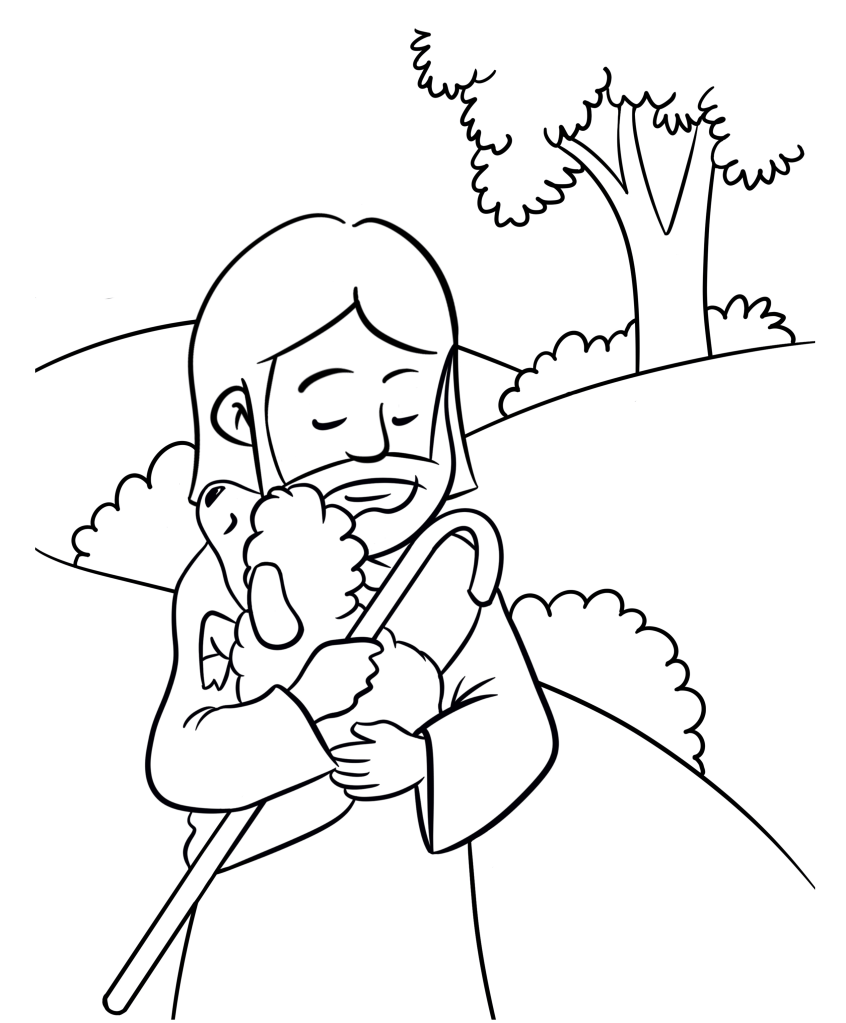
Once a shepherd had a flock of 100 sheep. Shepherds love their sheep. Sometimes they even have names for the sheep. A shepherd leads his sheep to nutritious green grass to eat. He looks for nice clean water so his sheep can have a drink when they are thirsty.
A shepherd watches after every sheep and takes care of them. Sometimes dangerous animals like bears and lions would come and try to hurt his sheep. The shepherd protects the sheep and chases all the dangerous animals away from them.
At other times the sheep would wander away from the rest of the sheep and the shepherd had to call out the sheep’s name. When the sheep heard the shepherd’s voice he would run back to the shepherd.
The shepherd loved every one of his sheep. He even had names for his sheep. Every night he would count his sheep to make sure that all 100 were there.
Jesus continued talking about the shepherd in the parable. One day the shepherd counted his sheep and found that there were only 99 sheep instead of 100. The shepherd was so worried. One of the sheep must be lost.
Even though 99 of the sheep were safe the shepherd was so concerned about the 1 sheep that was lost. Immediately, he left the other sheep in a safe place and set off looking for the lost sheep.
The shepherd searched everywhere. What if the sheep were hurt? What if some wild animals had attacked it?
Finally, he found the lost sheep! The shepherd was so relieved and happy.
The shepherd lifted the sheep up onto his shoulders and carried him all the way back to join the rest of the flock.
Every sheep is important to the shepherd. Even if only one is lost he will search everywhere to find it.
In the same way, people are important to God. He does not want anyone to be lost either. Every person is important to God.
Do you believe that people are important to God? If we know that someone is missing, what do you think we should do?
Scripture Reference: Matthew 18:10-14 and Luke 15:1-7
1 John

Do It Again Steven Curtis Chapman
Holy, Holy, Holy
“Holy, holy, holy! Lord God Almighty!
Early in the morning our song shall rise to Thee;
Holy, holy, holy, merciful and mighty!
God in three Persons, blessed Trinity!
Holy, holy, holy! All the saints adore Thee,
Casting down their golden crowns around the glassy sea;
Cherubim and seraphim falling down before Thee,
Who was, and is, and evermore shall be.
Holy, holy, holy! Though the darkness hide Thee,
Though the eye of sinful man Thy glory may not see;
Only Thou art holy; there is none beside Thee,
Perfect in pow’r, in love, and purity.
Holy, holy, holy! Lord God Almighty!
All Thy works shall praise Thy Name, in earth, and sky, and sea;
Holy, holy, holy; merciful and mighty!
God in three Persons, blessed Trinity!”
John Bacchus Dykes was an English clergyman and hymnwriter.
Parable of a Good Samaritan
Wherever Jesus went people would come to hear him tell about God. They loved to hear him tell parables. Parables were stories that helped people understand important lessons.
Once a man who was an expert in the Law of God asked Jesus a question, “Teacher, what must I do to live forever?”
Jesus knew that man was an expert in God’s Old Testament Laws. He asked the man what the Old Testament Law said that a person must do to live forever.
The man’s answer was, “Love the Lord your God with all your heart and with all your soul and with all your strength and with all your mind, and, Love your neighbor as yourself.”
Jesus told the man that he was right. That was the greatest commandment. That is the way to live forever.
Then the man asked about loving your neighbor as yourself. Did he have to love all his neighbors or just the ones that lived close by? He asked Jesus, “Who is my neighbor?”
Instead of telling him the answer Jesus told a parable. This is the parable:
A man was travelling by himself from Jerusalem to the town of Jericho. While he was on the road some robbers attacked him. They beat him up and took everything he had – even his clothes! The man was left all alone on the road. He waited and waited for someone to come by and help him.
A priest came walking by on the road. Priests were God’s helpers in the temple. They knew how to worship God. They knew all of the rules of God. Do you think the priest helped the man? No, the priest went to the other side of the road and passed right by the man without help.
Next, a Levite came along the road. Levites knew all of God’s laws. They were good Jews. Do you think the Levite stopped and helped the man? No, the Levite looked at the man and then crossed the road and walked right past him.
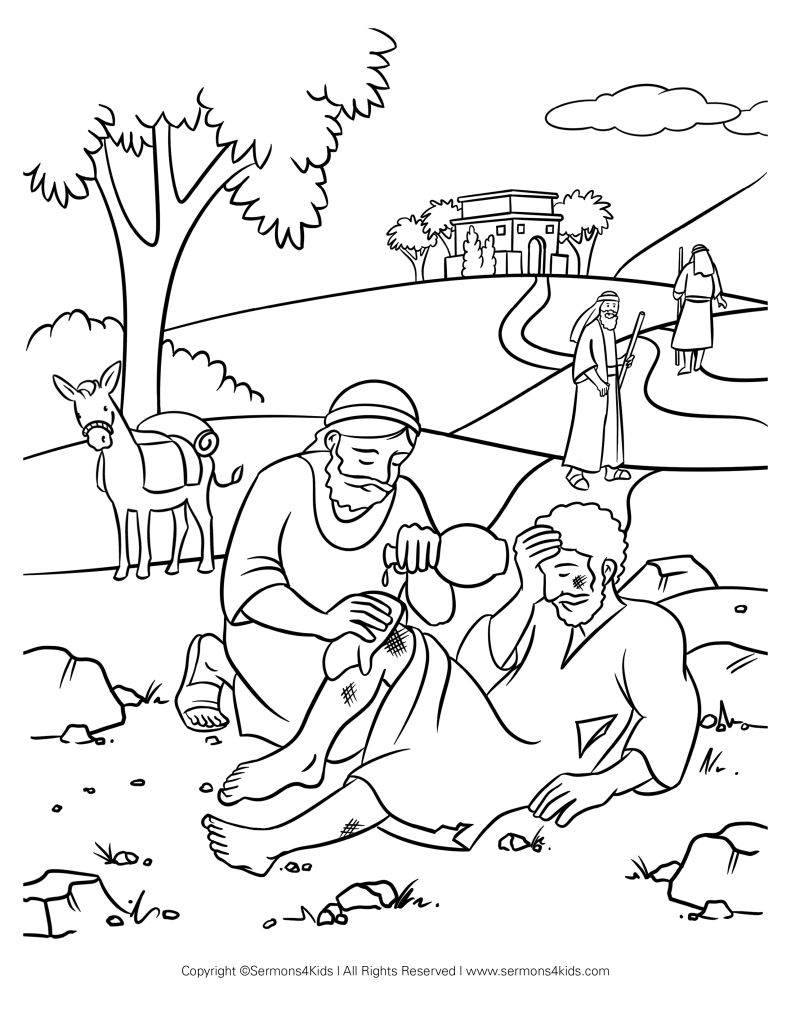
Finally, a man from Samaria came along the road. The Jews did not like Samaritans. Everybody thought that the Samaritans would never help anybody. But this Samaritan was good. He saw the man on the road, and he stopped to help. He put oil and wine on the man’s wounds. (Oil and wine were used for medicine in those times.) Then he lifted the man onto his donkey and took him to a nearby inn. He took care of the man all night to make sure he was going to be well.
The next morning the Samaritan had to leave to continue his journey. He wanted to make sure that the injured man was taken care of, so he gave money to the innkeeper. He gave him enough money so that the man could stay at the inn for two months! He even told the innkeeper that he would come back the next time he was travelling and pay more money if the man was still sick.
Everyone was very surprised to hear this parable. When Jesus was finished, he asked the expert in the Law of God a question, “Three men went on the road that day: the priest, the Levite and the Samaritan. Which of these men do you think was a neighbor to the man who was beaten and robbed?”
What do you think the expert in the Law of God answered? That’s right, the Samaritan was a neighbor. Helping anyone who needs help is being the kind of neighbor that God wants. We don’t even have to know the person. We should help them just because they need help.
Scripture Reference: Luke 10:25-37
 Shalom Talk