
I can do all things through…
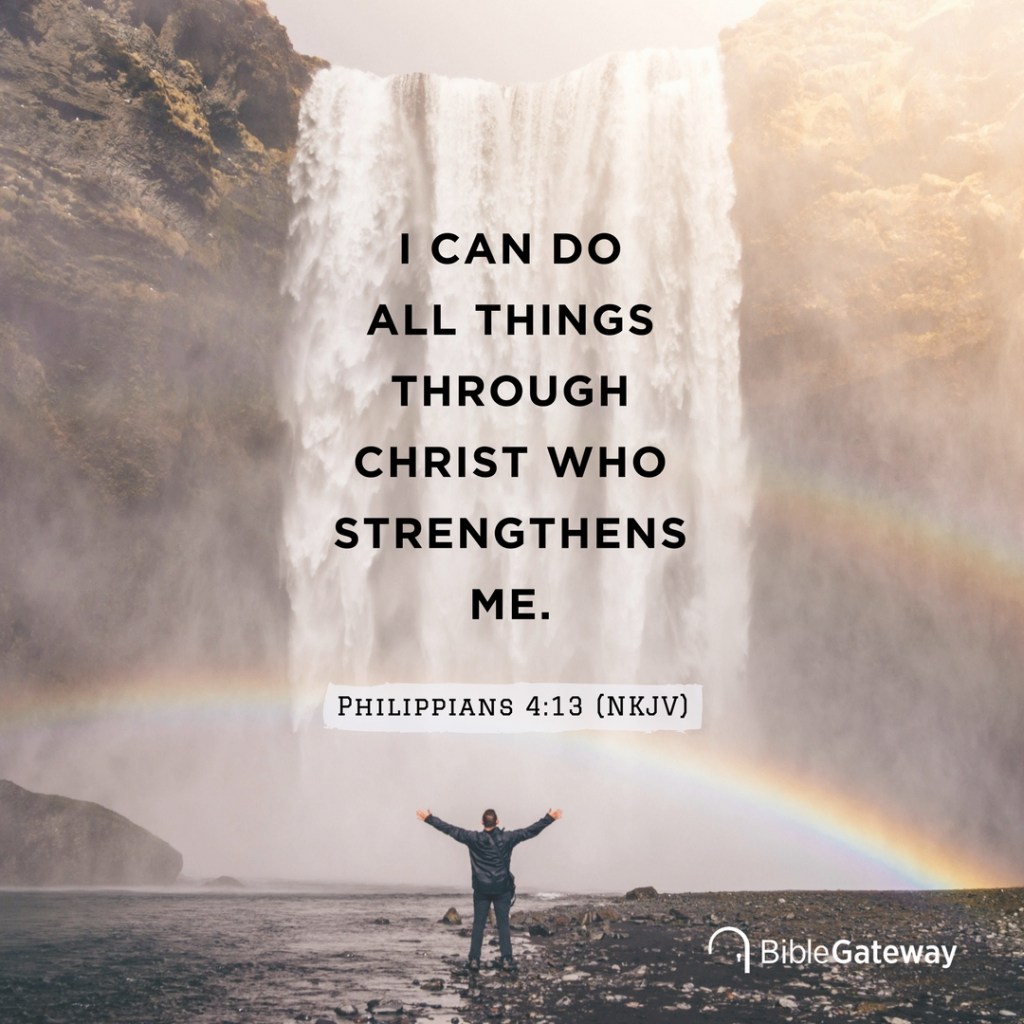
I can do all things through…
Jesus, my strength, my hope,
On thee I cast my care,
With humble confidence look up,
And know thou hearest prayer.
Give me on thee to wait,
Till I can all things do,
On thee, almighty to create,
Almighty to renew.I want a sober mind,
A self-renouncing will,
That tramples down and casts behind
The baits of pleasing ill;
A soul inured to pain,
To hardship, grief and loss,
Bold to take up, firm to sustain,
The consecrated cross.I want a godly fear,
A quick-discerning eye,
That looks to thee when sin is near,
And sees the tempter fly;
A spirit still prepared
And armed with jealous care,
For ever standing on its guard,
And watching unto prayer.I rest upon thy word;
The promise is for me;
My succour and salvation, Lord,
Shall surely come from thee.
But let me still abide,
Nor from my hope remove,
Till thou my patient spirit guide
Into thy perfect love.
—Charles Wesley (1707-1788)
Many people heard about Jesus. They heard that he was a good teacher and helped people to learn more about God. They heard that he could make sick people well. Sometimes big crowds of people would gather to hear Jesus speak.
One time Jesus and his apostles wanted to spend time together away from the big crowds of people. Where could they go to be alone? They decided to get into a boat and sail to the other side of the Sea of Galilee. They could rest and talk together in the quiet of the grassy green hills away from cities and people. So, they sailed across.
The Sea of Galilee is not very big. It is not actually a sea, but it is a lake. The people could see Jesus and his apostles landing the boat on the distant shore. The people wanted to be with Jesus so much that they decided to follow him. They walked around the lake to the other shore. Soon there was a huge crowd of people gathered again to hear Jesus preach. There were five thousand men plus women and children. Jesus knew that the people must really be serious if they walked all the way around the lake. He did not rest but spent all day teaching the people about God.
When evening came the apostles began to wonder how all of these people were going to eat. They were far away from any towns. Maybe Jesus should stop preaching so the people could walk to a town and buy some food. Jesus knew the apostles were worried. He asked one of the apostles, “Philip, where are we going to buy bread for all of these people?”
Philip was from a town near there and he knew that it would cost a lot to buy food for over five thousand people. Philip answered Jesus, “I would have to work for eight months to earn enough money to feed this crowd!”
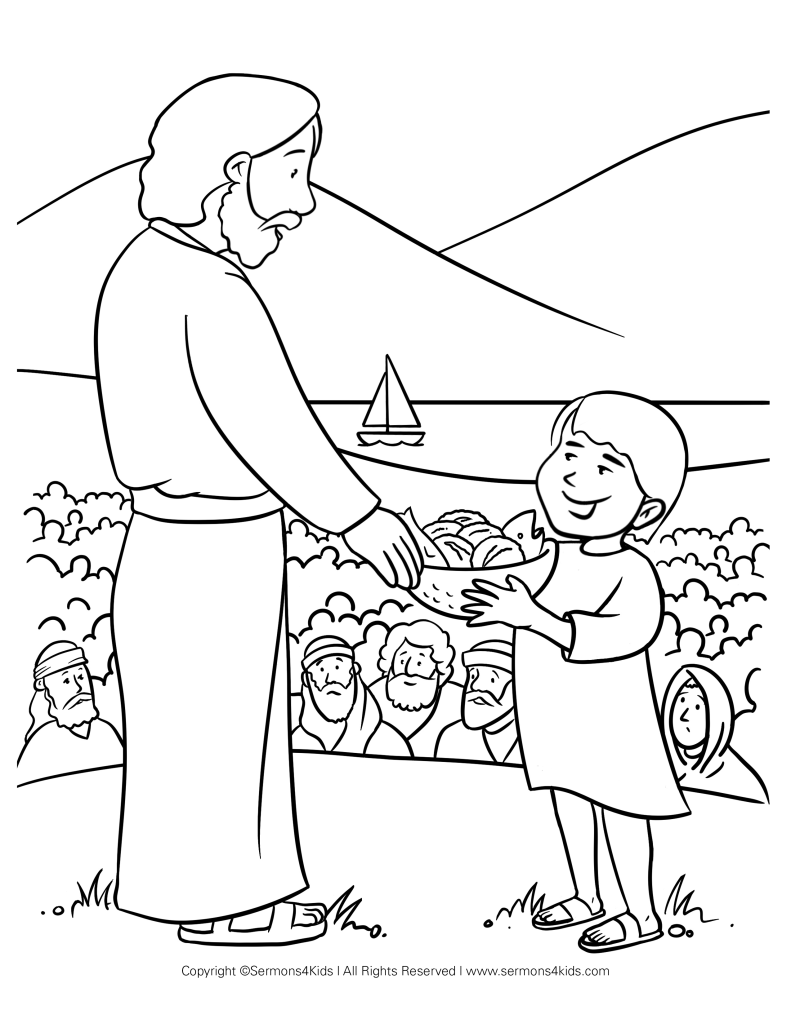
Andrew was another apostle. He had been asking people in the crowd if they had any food. He found one boy who had brought his lunch. The boy did not have much food. He only had two small fish and five small loaves of bread. Andrew did not know how this small amount would feed over five thousand people, but he took the food to Jesus anyway. He knew that Jesus could do anything!
Jesus said, “Divide all of the people into groups of fifty and tell them to sit down on the grass.” Soon the whole crowd was divided into small groups.
Then Jesus did a wonderful thing! He prayed to God to thank Him for the food and then he began handing bread and fish to people. Jesus began with only two fish and five loaves of bread but every time he handed it to someone, more bread and fish would appear. Jesus gave bread and fish to everyone in the whole crowd. Everyone ate bread and fish until they were full!
Finally, when everyone was finished, they cleaned up all of the small pieces of bread left over. The leftover bread was enough to fill twelve baskets full!
Jesus fed over five thousand people from two little fish and five small loaves of bread. Jesus was powerful enough to take care of a whole crowd of people. Jesus is powerful enough to take care of you and me.
3 Likewise, teach the older women to be reverent in the way they live, not to be slanderers or addicted to much wine, but to teach what is good.
4 Then they can urge the younger women to love their husbands and children,
5 to be self-controlled and pure, to be busy at home, to be kind, and to be subject to their husbands, so that no one will malign the word of God.
You’re here to be light, bringing…

C.S. Lewis
Lead us, Evolution, lead us
Up the future’s endless stair;
Chop us, change us, prod us, weed us.
For stagnation is despair:
Groping, guessing, yet progressing,
Lead us nobody knows where.
Wrong or justice, joy or sorrow,
In the present what are they
while there’s always jam-tomorrow,
While we tread the onward way?
Never knowing where we’re going,
We can never go astray.
To whatever variation
Our posterity may turn
Hairy, squashy, or crustacean,
Bulbous-eyed or square of stern,
Tusked or toothless, mild or ruthless,
Towards that unknown god we yearn.
Ask not if it’s god or devil,
Brethren, lest your words imply
Static norms of good and evil
(As in Plato) throned on high;
Such scholastic, inelastic,
Abstract yardsticks we deny.
Far too long have sages vainly
Glossed great Nature’s simple text;
He who runs can read it plainly,
‘Goodness = what comes next.’
By evolving, Life is solving
All the questions we perplexed.
Oh then! Value means survival-
Value. If our progeny
Spreads and spawns and licks each rival,
That will prove its deity
(Far from pleasant, by our present,
Standards, though it may well be).
C.S. Lewis (born November 29, 1898, Belfast, Ireland [now in Northern Ireland]—died November 22, 1963, Oxford, Oxfordshire, England) was an Irish-born scholar, novelist, and author of about 40 books, many of them on Christian apologetics, including The Screwtape Letters and Mere Christianity.

 Shalom Talk