Parable of an Unforgiving Servant

Peter, one of Jesus’ apostles, came to him and asked him a question. “Lord, how many times should I forgive someone when they do something wrong to me?”

Jesus knew that we should always forgive someone if they are sorry for what they have done. Instead of saying “always”, Jesus said, “Peter, you should forgive someone seventy-seven times!” Some versions of the bible even say, “seventy times seven”.

Then Jesus decided to tell Peter a parable to help him understand how important it is to forgive someone when they are sorry. A parable is a simple story that has a very important meaning. This is Jesus’ parable:

Once there was a king who was very rich. He had many servants who worked for him. Some servants were in charge of lots of the king’s money. They were also in charge of other servants.

The king checked to see if one of his servants cared for the money. When the king checked on the money, he discovered that his servant had not paid the bills but had borrowed the money for himself. It was not just a little money. The servant had borrowed thousands and thousands of dollars! He had borrowed so much money that he could never pay it back. This man had a huge debt.

At first, the king decided the only way to get his money back was to sell the servant and all of his family as slaves. The servant was very upset. His wife and children would all have to go and live in different places. They might never see each other again. The servant begged the king to forgive him for what he had done. He begged and begged him to not sell his family as slaves.

The king felt sorry for the servant. He decided to forgive the servant for borrowing thousands and thousands of dollars. He even told the servant that he would not have to repay the money.

Do you think the servant was happy? Do you think he was so happy that he treated everyone nicely that day? No, he did not.

When the servant left the king, he found another servant who owed him money. The servant only owed this man a few dollars. His debt was very small. Even though the king had been nice to him, the servant grabbed this man and began to choke him. He told him he would put him in prison until he paid back the few dollars.

Some of the other servants heard what had happened and went and told the king. What do you think the king thought? He had forgiven the servant a huge debt, but the servant could not forgive another even a small debt.

The king was very angry and threw the man in prison. He would have to stay in prison until the debt was paid.

Do you think Peter understood the parable that Jesus told him about forgiveness? The parable means that God has forgiven us for everything we have ever done wrong to him. He has forgiven us a huge debt! Now he wants us to forgive people when they are sorry for the bad things they do to us. God forgave us a huge debt like the king in the parable did and we should forgive others for their small debts against us. That’s what the servant in the parable should have done.

Scripture Reference:  Matthew 18:21-35

Reconnecting with God’s Promise

Written By Dan

It has been my observation while reading Psalm 115, our God reassures us that reconciliation and grace are always on the table, waiting for us to engage, waiting for us to yield. God made the earth we walk upon; he made all things on the earth for us. The earth was intended to be a cool place for us to live. It is unmistakably generated by God’s power, with his authority, and his immense wisdom. Yet, it pleases Him to make space for us to govern ourselves on earth and make use of his resources. His hand stretched out and created the heavens, he commanded all the hosts (angels) bringing them into existence, governing their activities and influence. All this is extremely good news for Israel, their God is creator and overseer of the universe.

Psalms 115: 1-11 says — Not to us Lord, not to us but to your name be the glory, because of your love and faithfulness. Why do the nations say, where is their God? Our God is in heaven; he does whatever pleases him. But their idols are silver and gold, made by human hands. They have mouths, but cannot speak, eyes, but cannot see. They have ears, but cannot hear, noses, but cannot smell. They have hands, but cannot feel, feet, but cannot walk, nor can they utter a sound with their throats. Those who make them will be like them, and so will all who trust in them. All you Israelites, trust in the Lord—he is their help and shield. House of Aaron, trust in the Lord—he is their help and shield. You who fear him, trust in the Lord—he is their help and shield. (NIV)

This is easy to ingest academically, but it is hard for me to wrap my mind around all this, to embrace it, and rely on it in everything we do or say. We are told in concrete language what God will do for us, that we might rest in his assurances, and build our life upon the notions of grace, redemption, and salvation. Let yourself think of this from God’s view. We are scheduled to last forever. Always around. Imagine one of your neighbors scheduled to be your neighbor forever. Always leaning in for more favors, wanting play time, wanting help in the yard, needing help to repair car troubles in the middle of the night, long endless talks. No relief – forever — 24/7 forever. Imagine a trillion of your closest neighbors always there forever. That is God’s perspective with a human flair. What an amazingly patient God we have. What human would design or plan this?

We have been given a remarkable gift. Liberty forever. This liberty has been proclaimed on the hilltops; God has put power into our hands. God has raised us up in righteousness, so that he may execute his promises through our hands. We are blessed.

What if I was an exiled Jew in Babylon; hoping (vaguely) for a return to a promised land I can barely remember. It seems like a hollow promise, never to be honored, but I say the words to stay out of trouble with my Jewish neighbors. I wait, wondering if the promise might be true. And then comes Cyrus. He closes in on my Babylon; we are anxious, not sure what will happen. Then it becomes clear. Cyrus captures the city and seems to be a reasonable person. Then Cyrus talks about sending the Jews home. Cyrus says he plans to facilitate the rebuilding of Jerusalem. How could I have planned that? Could this happen? The promise seemed like a bridge too far, but now things are changing. Who is this God? My Goodness. What is next?

Then I heard we are leaving for Jerusalem in a few days. We were captives, now we are a migrating nation, heading home. Home. How could this happen? Our bondage is over. God has redeemed us. He really did what he said he would do. Selah. Assuming the New Covenant and grace are part of your life, Elohim’s unmerited affection underscores a promise. The promise? We are heading home.

I choose Jesus.

Obstacles to the Plan

Written By Dan

It was my observation while reading Deuteronomy that we are instructed to Love the Lord our God with all our heart and with all our soul and with all our strength and with all our mind (Deuteronomy 6:5). Additionally, I noted considerable New Testament guidance on how to wrap your heart around God.

For example — Show earnestness in realizing the full assurance of hope to the end (Hebrews 6:11); Love one another earnestly from the heart (1 Peter 1:22); Strive to enter by the narrow gate (Luke 13:24); Labor for the food that endures to eternal life (John 6:27); Be steadfast, immovable, always abounding in the word of the Lord (1 Corinthians 15:58); Let us not be weary in well-doing, for we shall reap if we do not faint (Ephesians 5:15); and Work out your own salvation with fear and trembling (Philippians 2:12).

Additionally, Titus 2: 11-15 says — For the grace of God has appeared that offers salvation to all people. It teaches us to say “No” to ungodliness and worldly passions, and to live self-controlled, upright and godly lives in this present age, while we wait for the blessed hope—the appearing of the glory of our great God and Savior, Jesus Christ, who gave himself for us to redeem us from all wickedness and to purify for himself a people that are his very own, eager to do what is good. These, then, are the things you should teach. Encourage and rebuke with all authority. Do not let anyone despise you. (NIV)

How do we respond to this extensive set of guidelines from Scripture? We strive to be like Jesus. We labor to find his pace, his stride. We abound in hunger for scripture. We become zealous and earnest for the peace of God. We find the path away from laziness and lukewarmness. We take to the run, with the stride and confidence held by a winner. Jesus makes us a winner. For Jesus has placed this mantle of strength upon us to operate in this world but not be corrupted by this world. We immerse ourselves in the strength he supplies to magnify His glory.

So, what do we do? I think we are to lay aside the heavy load upon our backs, the sin of this world that surrounds and covers us like a heavy scratchy wool blanket. An experienced runners discards everything but what is necessary; this is also true for spiritual racing. Then we find our stride and enter the race. We run the race with patience and endurance. To run this race, I work to lay aside all the things that hinder me, that nip at my heals, I bring plans to guide my feet. The obstacles are there to keep me from being the man that God called me to be. The obstacles are there to neuter the calling I received from God. Then I need to bring up the more slippery obstacles. Paul referred to them as disputable issues.

Romans 14:1-4 says — Accept the one whose faith is weak, without quarreling over disputable matters. One person’s faith allows them to eat anything, but another, whose faith is weak, eats only vegetables. The one who eats everything must not treat with contempt the one who does not, and the one who does not eat everything must not judge the one who does, for God has accepted them. Who are you to judge someone else’s servant? To their own master, servants stand or fall. And they will stand, for the Lord is able to make them stand.

There will be things that people, convinced they know best, will impose on others, using vague scripture to make their case. We must be careful not to become entwined in disputes over vague issues. They are nothing more than speedbumps. Nothing more than obstacles to the plan.

I choose Jesus.

Parable of a Prodigal Son

Jesus told a parable about a man with two sons. A parable is a simple story to help people understand something hard to understand – something that is important to understand.

In this parable, a man had two sons. The father knew that someday he would get very old and die. When he died, all his money, house, and farm would be given to his two sons. The money and property that children receive from someone who dies is called an “inheritance”.

The younger son was very impatient. He did not want to wait for his father to die to get his inheritance. He wanted his father’s money soon so he could go and spend it. He asked his father to divide the money and give him his part. The father wanted his son to be happy, so he did as his son asked. He divided the money and gave half to his youngest son.

The younger son took all the money and left home. He went to live in another country that was very far from his home. He bought everything that he wanted. He spent money on parties and wasteful things. People liked him because he had lots of money and bought things for them.

The problem was that soon the money ran out. He had no more money for parties, and his friends stopped liking him. It turns out that they weren’t real friends after all. They only liked him when he bought them things. Now that he had no money, they did not even want to be around him.

Soon, the younger son ran out of food and became very hungry. He had to think of a way to earn money, or he would starve!

The situation became even more serious because there was a famine in the country where the son lived. That meant that there was hardly any food for anyone to eat. Many other people were hungry. too

A farmer who owned pigs needed a helper, so the son began to work for the farmer. His job was to feed the pigs. The son was so hungry that even the pig food started to look good to him.

Finally, the son began to think about his bad choices. He thought about his father and brother. At home, people loved him. At home, there was plenty of food.

The son began to realize that he had made a terrible mistake. He should never have asked his father to give him the money early. He should have been patient. If only he could go back in time and be a good son.

“But it is too late now,” he thought. “I have done many bad things. I am not good enough to be a son now. My father would never forgive me and take me back.”

But the son had another idea. His father had many workers and many jobs to do. They worked hard but at least they had enough food. If he asked his father nicely, then maybe his father would allow him to be one of the workers. He could take care of the animals and work hard.

So, the son decided to return home.

The son thought the father would be angry, but as he got closer to his old home, he was shocked to see his father running to meet him.

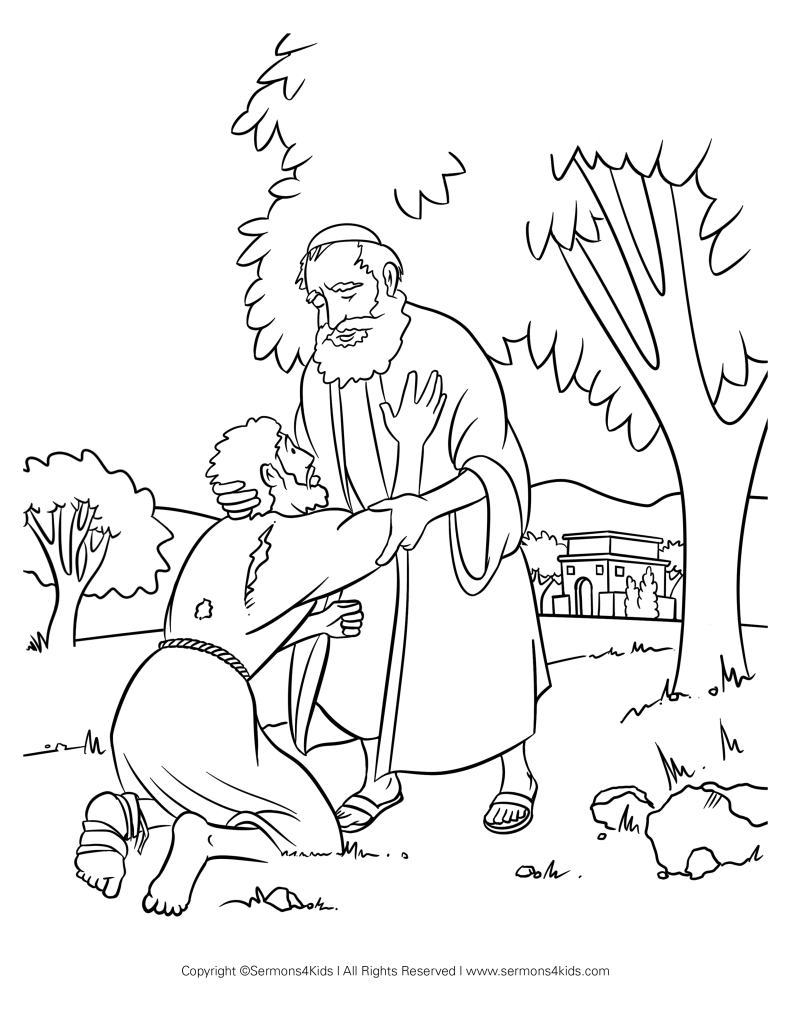
When the father saw his son coming, he was filled with love for him. He was so happy to see his son that he threw his arms around him and gave him a big hug and a kiss. “My son has returned to me!” his father cried.

The son said, “I am sorry, but I have done terrible things. I do not deserve to be your son. I can just be one of your workers.”

But the father did not treat him like a servant at all. He welcomed him home as his son. He told the servants to cook a big dinner. He put a beautiful robe on his son. He put a ring on his finger and special sandals on his feet.

“I thought my son was dead, and I would never see him again. But my son has come back to me!” the father said. “He was lost, but now he is found.”

The father had a special meal prepared, and everyone in the household celebrated.

Almost everyone, that is. When the older son saw everyone celebrating, he became jealous and very unhappy. “This is not fair,” he thought. “I have been the good son all along, but I am not getting the attention. I never left home and spent all the money, but nobody is having a party for me.”

But the father went to the older son and told him he loved him too. He explained to the son why he was so happy. “Don’t you understand, son? I am so happy because I thought my son was dead, but now I know he is alive!”

“He came back to me. He was lost, but now he is found!” he continued, “Please, let’s celebrate together.”

Jesus told this parable so that people would understand something about God. Sometimes we are like the young son in the parable. We do wrong things. We start to feel very bad. We might think that God would never forgive us.

But God does forgive us! When we tell God we are sorry, he is so happy. He is happy because he loves us and always wants us to do the right thing.

Do you think God will love you and forgive you if you tell him you are sorry for something?

Scripture Reference: Luke 15:11-32