Unmerited Grace for All

Written By Dan

It has been my observation that we Christians look to the Bible for lasting meaning and hope; this search allows us to use our reasoning abilities as God intended. The Bible presents the reality of God (implied in Revelation 1:8), who has revealed Himself to all people (implied in Psalms 19:1-2).

The apostle Paul argued this point when he wrote, “since the creation of the world His invisible attributes, eternal power, and divine nature have been clearly seen; being understood through what has been made, so that they are without excuse” (Romans 1:20). This declaration, in which God reveals Himself through nature, is also shown to the heart of every person, for “that which is known about God is evident within them; for God made it evident to them” (Romans 1:19).

John Calvin referred to this as the ‘sensus divinitatis’, which is an innate sense of divinity, an intuitive knowledge that God exists. Calvin wrote, “there exists in the human mind and indeed by natural instinct, some sense of Deity.” He further states, “All men of sound judgment will therefore hold, that a sense of Deity is indelibly engraved on the human heart.” Calvin also wrote, “there never has been, from the very first, any corner of the globe, any city, any household, without religion, [which] amounts to a tacit confession, that a sense of Deity is inscribed on every heart.”

The problem is not with God’s clear revelation, but with the human heart which is rebellious. For those possessed with sinful persistence, they suppress the truth with their unrighteousness (implied in Romans 1:18). These rebels have a sinful heart that ignores God’s grace to pursue earthly passions.

In Romans 1:21-23 Paul wrote — For although they knew God, they neither glorified him as God nor gave thanks to him, but their thinking became futile, and their foolish hearts were darkened. Although they claimed to be wise, they became fools and exchanged the glory of the immortal God for images made to look like a mortal human being and birds and animals and reptiles. (NIV).

God never forces Himself on anyone. People are free to choose whether to accept Him or not. If they reject the gentle nudge from the Spirit of God, he does not render the final judgment upon them right away. Rather, God extends to them an undeserved period of kindness and goodness, regardless of whether they have yielded to grace or continue rebelling (implied in John 3:16). But death brings the period of kindness to closure.

This grace is dependent on God and not the attitude or actions of men. Jesus said of His Father, that “He causes His sun to rise on the evil and the good and sends rain on the righteous and the unrighteous” (Matthew 5:45). Paul affirmed this grace, saying, “In the generations gone by, He permitted all the nations to go their own ways [in rebellion]; and yet He did not leave Himself without witness, in that He did good and gave you rains from heaven and fruitful seasons, satisfying your hearts with food and gladness” (Acts 14:16-17). Here, God’s grace is obvious, Elohim provides what we need. He even blesses the unsaved and unrepentant. His love, mercy, and goodness are extended toward the undeserving entirely because of his earnest goal to see all of us yield to Grace before we die.

Salvation comes to us by grace alone (it is an undeserved gift), through faith alone (adding no works), by Jesus alone (as the only One who saves). Paul wrote, “For by grace you have been saved through faith; and that is not of yourselves, it is the gift of God; not as a result of works, so that no one may boast” (Ephesians 2:8-9). Salvation comes to us via the death, burial, and resurrection of Jesus (implied in Romans 10:9). We deserve death; but grace abounds through the ransom paid by the Lamb of God.

I choose Jesus.
Declare what is Right.

Written By Dan

It has been my observation that we see a recurring message in scripture that Elohim is to be trusted above all else in this universe.  Idols are man’s creation – they have zero power, they are inert, lifeless, useless. Elohim reveals himself when it is necessary to accomplish a goal or we are in trouble. When our free will gets us into mischief then God intervenes as necessary to be sure we do not get too far into the weeds.

Isaiah 45:15-19 says — All the makers of idols will be put to shame and disgrace together. But Israel will be saved by the Lord with an everlasting salvation; you will never be put to shame or disgraced, for the ages everlasting. For this is what the Lord says— he who created the heavens, he is God; he who fashioned and made the earth, he founded it; he did not create it to be empty but formed it to be inhabited— he says: I am the Lord, and there is no other. I have not spoken in secret, from somewhere in a land of darkness; I have not said to Jacob’s descendants, Seek me in vain. I, the Lord, speak the truth; I declare what is right. (NIV)

Isaiah mentions the everlasting salvation to be sure we are not discouraged too much.  Yet, Elohim must be true to his own sense of fair play and justice, if we make mistakes and fail to repent then we can expect issues. Sometimes, if training is required, even with repentance, issues come our way. Our job?  Stay focused. Keep our eye on God. The growth of God’s people is delivered in layers of grace and training. We learn, we get better, but we still seem to stumble. Fortunately, Elohim is longsuffering and patient with us. He knows how timid and helpless we are when faced with huge obstacles. Elohim knows we charge ahead foolishly and get ourselves all tangled up in the brambles. He smiles, then at the right time Elohim pulls us out of trouble, every time. The Spirit of the Lord is always working on our heart (implied in Zechariah 4:6), therefore the accidental troubles we encounter are mere speedbumps.

Isaiah 57:14-16 says – Build up, build up, prepare the road! Remove the obstacles out of the way of my people. For this is what the high and exalted One says—he who lives forever, whose name is holy: I live in a high and holy place, but also with the one who is contrite and lowly in spirit, to revive the spirit of the lowly and to revive the heart of the contrite. I will not accuse them forever, nor will I always be angry for then they would faint away because of me—the very people I have created. (NIV)

The people who make our distractions (graven objects) sometimes create public personalities that we aspire to be like (worship).  They are makers of Idols (chaff).  Then they say — you need this thing or you need to hear this or you need to see this event if you want to live life to the fullest.  They quietly place a fence about our life — we find ourselves generating loads of activity as we aspire to emulate the public personalities or accomplish the specified objectives. We are trapped.

The deeper truth — It is God’s hope that we get still, listen to the Holy Spirit, and reassign our adulation to the one true living God. The makers of the public personas and distractions often see the emptiness themselves and they pull away from the façade as they get a bit older. They become more honest in their messaging and we all benefit. Consider the transition of some aging rock stars as they settle down, abandon drugs, and start leading godly lives.  Usually, something occurred in their life (an uncomfortable event) that helped them to see their sin and yield to the one true living God. It is amazing to see this happen with people– we all need Jesus – it does not matter what we do or how we live – we all need the one true living God.  In this transformation – we are able to declare what is right and live for God.

I choose Jesus.

It Is Well

“When peace, like a river, attendeth my way,
When sorrows like sea billows roll;
Whatever my lot, Thou hast taught me to say,
It is well, it is well with my soul.

It is well with my soul,
It is well, it is well with my soul.

Though Satan should buffet, though trials should come,
Let this blest assurance control,
That Christ hath regarded my helpless estate,
And hath shed His own blood for my soul.

My sin—oh, the bliss of this glorious thought!—
My sin, not in part but the whole,
Is nailed to the cross, and I bear it no more,
Praise the Lord, praise the Lord, O my soul!

For me, be it Christ, be it Christ hence to live:
If Jordan above me shall roll,
No pang shall be mine, for in death as in life
Thou wilt whisper Thy peace to my soul.

But, Lord, ’tis for Thee, for Thy coming we wait,
The sky, not the grave, is our goal;
Oh, trump of the angel! Oh, voice of the Lord!
Blessed hope, blessed rest of my soul!

And Lord, haste the day when the faith shall be sight,
The clouds be rolled back as a scroll;
The trump shall resound, and the Lord shall descend,
Even so, it is well with my soul.”

Horatio Gates Spafford was an American lawyer and Presbyterian church elder. He is best known for penning the Christian hymn “It Is Well With My Soul” following the Great Chicago Fire and the deaths of his four daughters on a transatlantic voyage aboard the S.S. Ville du Havre.

Parable of a Lost Sheep

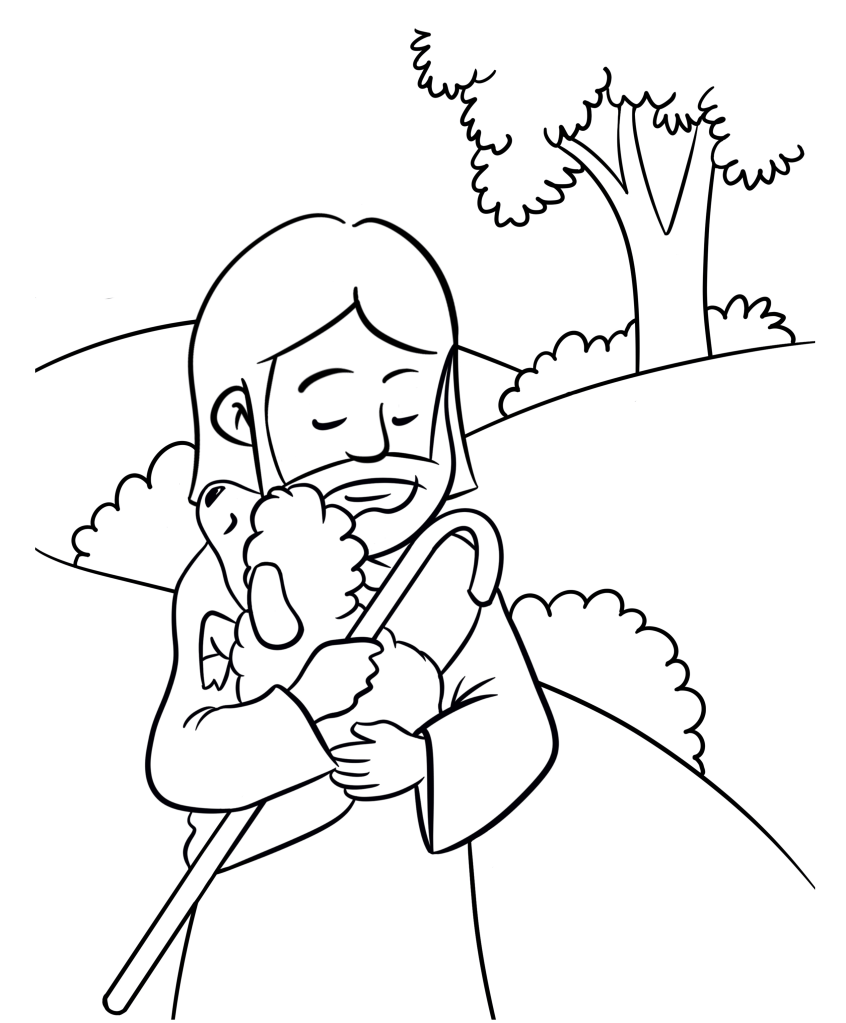
Once a shepherd had a flock of 100 sheep. Shepherds love their sheep. Sometimes they even have names for the sheep. A shepherd leads his sheep to nutritious green grass to eat. He looks for nice clean water so his sheep can have a drink when they are thirsty.

A shepherd watches after every sheep and takes care of them. Sometimes dangerous animals like bears and lions would come and try to hurt his sheep. The shepherd protects the sheep and chases all the dangerous animals away from them.

At other times the sheep would wander away from the rest of the sheep and the shepherd had to call out the sheep’s name. When the sheep heard the shepherd’s voice he would run back to the shepherd.

The shepherd loved every one of his sheep. He even had names for his sheep. Every night he would count his sheep to make sure that all 100 were there.

Jesus continued talking about the shepherd in the parable. One day the shepherd counted his sheep and found that there were only 99 sheep instead of 100. The shepherd was so worried.  One of the sheep must be lost.

Even though 99 of the sheep were safe the shepherd was so concerned about the 1 sheep that was lost. Immediately, he left the other sheep in a safe place and set off looking for the lost sheep.

The shepherd searched everywhere. What if the sheep were hurt? What if some wild animals had attacked it?

Finally, he found the lost sheep! The shepherd was so relieved and happy.

The shepherd lifted the sheep up onto his shoulders and carried him all the way back to join the rest of the flock.

Every sheep is important to the shepherd. Even if only one is lost he will search everywhere to find it.

In the same way, people are important to God.  He does not want anyone to be lost either.  Every person is important to God.

Do you believe that people are important to God?  If we know that someone is missing, what do you think we should do?

Scripture Reference: Matthew 18:10-14 and Luke 15:1-7

Ecclesiastes 5:18-20

The Message

18-20 After looking at the way things are on this earth, here’s what I’ve decided is the best way to live: Take care of yourself, have a good time, and make the most of whatever job you have for as long as God gives you life. And that’s about it. That’s the human lot. Yes, we should make the most of what God gives, both the bounty and the capacity to enjoy it, accepting what’s given and delighting in the work. It’s God’s gift! God deals out joy in the present, the now. It’s useless to brood over how long we might live.