Announcements from the Angelic Host

Essay By Dan

It has been my observation that angels are remarkable creatures, God created a wonderful group of beings that quietly move with power and grace behind the spotlight. I read a while back in a Billy Graham book they could be called God’s Secret Agents, not seeking to draw attention to themselves, but to do God’s bidding. One of the reasons I think we may not be personally aware of angels in our life is because they are able to do their job without a revelation to us. The Bible cites a limited number of instances when God has given us a glimpse of these beings at work.

The Bible does not precisely say how many angels exist. It was a “multitude” of the heavenly host that told the shepherds of Jesus’ birth (Luke 2:13). Daniel 7:10 tells us — Thousands upon thousands attended him; ten thousand times ten thousand stood before him. (NIV). That would suggest there are at least one hundred million angels—I suspect the host of angels is a force too vast to imagine. Perhaps that is why Job 25:3 asks — Can His forces be numbered? (NIV).

I wonder sometimes why Scripture does not provide a precise description of how angels look. We do have some verbal imagery; therefore, we know they can appear in different forms. Occasionally angels appear as ordinary humans; we are told it is possible to interact with angels without knowing. Hebrews 13:2 tells us — Do not forget to show hospitality to strangers, for by so doing some people have shown hospitality to angels without knowing it (NIV).

Even though angels can be overwhelming in appearance, we should not worship angels. John tells us in Revelations 19:9-10 — the angel said … ‘Blessed are those who are invited to the wedding supper of the Lamb!’ And he added, ‘These are the true words of God.’ At this I fell at his feet to worship him. But he said to me, ‘Do not do that! I am a fellow servant with you and with your brothers and sisters who hold to the testimony of Jesus. Worship God! It is the Spirit of prophecy who bears testimony to Jesus’ (NIV).

A second time in Revelation 22:8–9 John tells us — when I heard and saw, I fell down to worship before the feet of the angel who showed me these things. Then he said to me, ‘See that you do not do that. For I am your fellow servant, and of your brethren the prophets, and of those who keep the words of this book. Worship God’ (NIV). The angel would not accept John’s worship.

It seems prudent to mention Lucifer. I am not interested in promoting his role, I shall not magnify his feral rebellion. But it is necessary to mention him because we may encounter an angel with a message at some point in our Walk with God. We know there are holy angels and unholy ones (fallen angels or demons). If an awe-inspiring angelic being were to appear to us right now, we would be inclined to believe just about anything he said—it is hard to not be awestruck by something so powerful.

What do we do? Scripture tells us to assess any so-called angel’s message (or a teaching from any source) with what we find in God’s Word. “But even if we, or an angel from Heaven, preach any other teaching to you than what we have preached to you, let him be cursed” (Galatians 1:8 paraphrased). Simple? Ya. But we need to guard our hearts. We need to keep our wits about us. Test first. Evaluate any message that appears to be from a heavenly source before you commit. Align the message you are hearing with scripture. If it does not align with scripture, then discard the message. The Word of God does not lie, it is absolute truth. Trust the Logos. Trust the Word of God over all other messages.

I choose Jesus.

Hovering over the Waters

Essay By Dan

It has been my observation while Walking with God that the more you learn about the Holy Spirit the easier it is to hear his voice, feel his nudge, and recognize when he is influencing or pressing to influence a decision you are making. When did the Holy Spirit first appear? In the second verse of Genesis, we read — In the beginning God created the heavens and the earth. The earth was formless and empty, darkness was over the surface of the deep, and the Spirit of God was hovering over the waters (Genesis 1:2). Before anything was created, the Spirit was present, hovering, observing, and pondering on us. Us!

After the escape from Egypt, the Hebrews wandered about the desert for 40 years. They could have made the journey in about 11 days. But they were a stubborn lot and God kept them wandering to bring them under control. Noting the struggles of Moses, God took steps to reduce his workload.

In Numbers we read — The LORD said to Moses, gather for Me seventy men whom you know to be the elders of the people and officers over them. I will take the Spirit that is on you and put it on them; they will share the burden of the people; you will not be alone (Numbers 11:16-17 paraphrased). This action really helped Moses govern the Hebrews. Notice the presence of the Holy Spirit.

There are other places that provide a clear signal that the Holy Spirit was on the job. For example, King David was very personable; he was charming, open, and appreciated by his people in his early years. David tells us — The Spirit of the LORD spoke through me; His word was on my tongue (2 Samuel 23:2). Once again, we see decisive guidance by the Holy Spirit provided to people who had faith. David learned to be responsive to the nudge of the Holy Spirit.

Yet there were problems. David struggled with desire. Uriah was one of the mighty men who surrounded and protected David from trouble in the early years (2 Samuel 23:39). Uriah had a strikingly beautiful wife. David, overcome by foolishness, had Uriah killed to take Bathsheba for himself. Not a good plan. David repented. Elohim forgave David. But his failure to listen led to consequences.

After Bathsheba, things went south for David (see 2 Samuel chapter 13-24). Bathsheba’s first born died seven days after birth. (2 Samuel 12:15–23). Nathan said — The sword shall never depart from your house (2 Samuel 12:10). David found his kingdom constantly in trouble and shredded by two civil wars. Nathan said — I [the Lord] will raise up evil against you out of your own house (2 Samuel 12:11–12). David’s sons Amnon and Absalom were very violent, life was cheap in those days. Yet, Bathsheba, David, and Solomon were specified in the DNA lineage defined for Jesus (see Matthew 1:6). That is Forgiveness!

God was not done with us. Isaiah wrote — A shoot will come up from the stump of Jesse; from His roots a branch will bear fruit. The Spirit of the LORD will rest on Him — the Spirit of wisdom, of understanding, counsel and might, the Spirit of the knowledge and fear of the LORD (Isaiah 11:1-2 paraphrased).

This message makes it clear the Holy Spirit knew about the new covenant, even as he hovered above the waters in Genesis 1:2 (God’s foreknowledge). Jesus, in the bloodline of David and Bathsheba, was to be the one true living King, the Messiah. Jesus exuded the wisdom, power, clarity, and knowledge of God.

Learning to hear the Holy Spirit’s voice was an issue for Moses, David, and Isaiah. They all figured it out. They all found a way to differentiate between the Holy Spirit and their internal self-talk. You will figure it out too. Knowing the voice of God is part of how we are designed. Start now, listening, evaluating the message with scripture. Grow close to the nudge and voice. He will talk to you. He will. Be still and listen.

I choose Jesus.

Holy, Holy, Holy

“Holy, holy, holy! Lord God Almighty!
Early in the morning our song shall rise to Thee;

Holy, holy, holy, merciful and mighty!
God in three Persons, blessed Trinity!

Holy, holy, holy! All the saints adore Thee,
Casting down their golden crowns around the glassy sea;
Cherubim and seraphim falling down before Thee,
Who was, and is, and evermore shall be.

Holy, holy, holy! Though the darkness hide Thee,
Though the eye of sinful man Thy glory may not see;
Only Thou art holy; there is none beside Thee,
Perfect in pow’r, in love, and purity.

Holy, holy, holy! Lord God Almighty!
All Thy works shall praise Thy Name, in earth, and sky, and sea;

Holy, holy, holy; merciful and mighty!
God in three Persons, blessed Trinity!”

John Bacchus Dykes was an English clergyman and hymnwriter.

Parable of a Good Samaritan

Wherever Jesus went people would come to hear him tell about God. They loved to hear him tell parables. Parables were stories that helped people understand important lessons.

Once a man who was an expert in the Law of God asked Jesus a question, “Teacher, what must I do to live forever?”

Jesus knew that man was an expert in God’s Old Testament Laws. He asked the man what the Old Testament Law said that a person must do to live forever.

The man’s answer was, “Love the Lord your God with all your heart and with all your soul and with all your strength and with all your mind, and, Love your neighbor as yourself.”

Jesus told the man that he was right. That was the greatest commandment. That is the way to live forever.

Then the man asked about loving your neighbor as yourself. Did he have to love all his neighbors or just the ones that lived close by? He asked Jesus, “Who is my neighbor?”

Instead of telling him the answer Jesus told a parable. This is the parable:

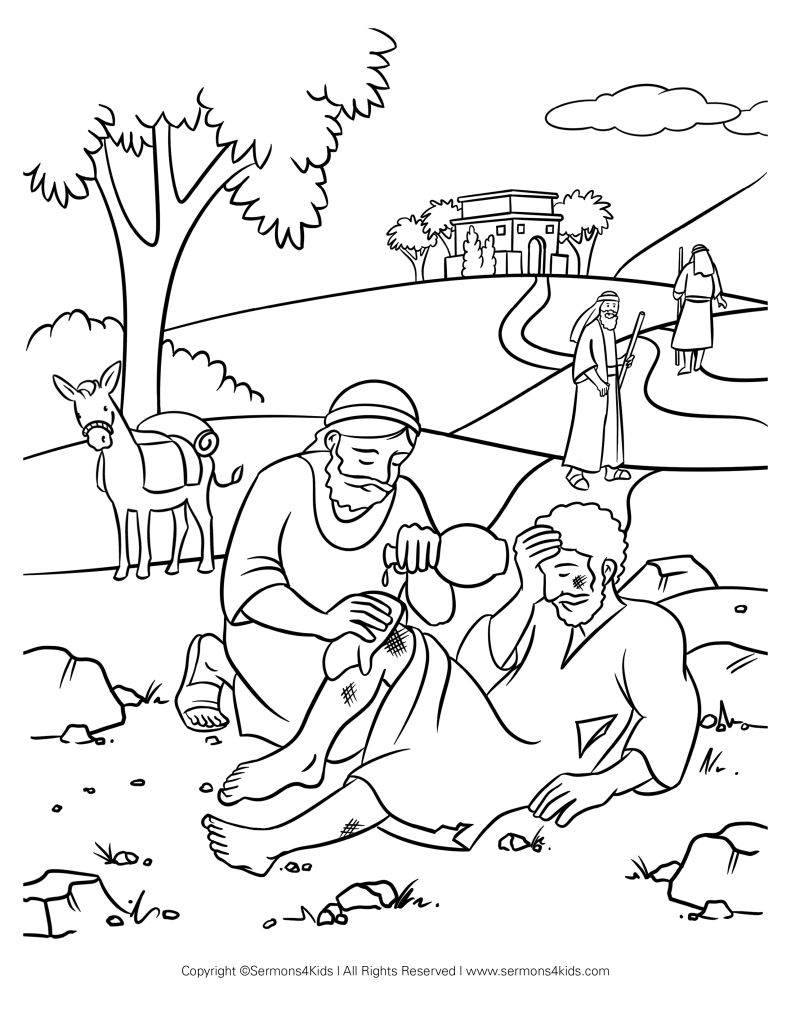
A man was travelling by himself from Jerusalem to the town of Jericho. While he was on the road some robbers attacked him. They beat him up and took everything he had – even his clothes! The man was left all alone on the road. He waited and waited for someone to come by and help him.

A priest came walking by on the road. Priests were God’s helpers in the temple. They knew how to worship God. They knew all of the rules of God. Do you think the priest helped the man? No, the priest went to the other side of the road and passed right by the man without help.

Next, a Levite came along the road. Levites knew all of God’s laws. They were good Jews. Do you think the Levite stopped and helped the man? No, the Levite looked at the man and then crossed the road and walked right past him.

Finally, a man from Samaria came along the road. The Jews did not like Samaritans. Everybody thought that the Samaritans would never help anybody. But this Samaritan was good. He saw the man on the road, and he stopped to help. He put oil and wine on the man’s wounds. (Oil and wine were used for medicine in those times.) Then he lifted the man onto his donkey and took him to a nearby inn. He took care of the man all night to make sure he was going to be well.

The next morning the Samaritan had to leave to continue his journey. He wanted to make sure that the injured man was taken care of, so he gave money to the innkeeper. He gave him enough money so that the man could stay at the inn for two months! He even told the innkeeper that he would come back the next time he was travelling and pay more money if the man was still sick.

Everyone was very surprised to hear this parable. When Jesus was finished, he asked the expert in the Law of God a question, “Three men went on the road that day: the priest, the Levite and the Samaritan. Which of these men do you think was a neighbor to the man who was beaten and robbed?”

What do you think the expert in the Law of God answered? That’s right, the Samaritan was a neighbor. Helping anyone who needs help is being the kind of neighbor that God wants. We don’t even have to know the person. We should help them just because they need help.

Scripture Reference: Luke 10:25-37

Psalms 90:10-17

The Message

3-11 So don’t return us to mud, saying,
    “Back to where you came from!”
Patience! You’ve got all the time in the world—whether
    a thousand years or a day, it’s all the same to you.
Are we no more to you than a wispy dream,
    no more than a blade of grass
That springs up gloriously with the rising sun
    and is cut down without a second thought?
Your anger is far and away too much for us;
    we’re at the end of our rope.
You keep track of all our sins; every misdeed
    since we were children is entered in your books.
All we can remember is that frown on your face.
    Is that all we’re ever going to get?
We live for seventy years or so
    (with luck we might make it to eighty),
And what do we have to show for it? Trouble.
    Toil and trouble and a marker in the graveyard.
Who can make sense of such rage,
    such anger against the very ones who fear you?

12-17 Oh! Teach us to live well!
    Teach us to live wisely and well!
Come back, God—how long do we have to wait?—
    and treat your servants with kindness for a change.
Surprise us with love at daybreak;
    then we’ll skip and dance all the day long.
Make up for the bad times with some good times;
    we’ve seen enough evil to last a lifetime.
Let your servants see what you’re best at—
    the ways you rule and bless your children.
And let the loveliness of our Lord, our God, rest on us,
    confirming the work that we do.
    Oh, yes. Affirm the work that we do!