Writing Love in Our Heart

Essay By Dan

It was my observation while learning about the mediator function held by Jesus that I was not very knowledgeable about the origins of sacrifice as defined by scripture. I followed this tangent and started learning. In the book of Leviticus, the Israelites were instructed by God on the topic of sacrifice. In my view, the notion of sacrifice is a God directed process where blessings are appropriated through the offering of a specified element for a specified sin. But I must be clear – the sacrifice begins and ends with God. In His kindness, He provides this avenue to his people so that they, by faith, might receive grace.

When I looked for the first sacrifice, I noted that God covered Adam and Eve with animal skins. These animals were used (sacrificed) to address Adam and Eve’s rebellion (Genesis 3:21). This event was not specifically called a sacrifice, but the metaphor is clear. Their sin (rebellion) was covered (literally with skins) by the death (shed blood) of another being. Their anxiety was relieved, and they were willing to talk with God once the coverings were in place. The next sacrifice occurs when Abel offers a sacrificial animal (firstling) as gratitude for a good year of crops (Genesis 4:3-5). I should mention — Abel’s attitude was correct, the sacrifice was effective; Cain’s attitude was incorrect, his sacrifice was not accepted.

The Lord said to Moses in Leviticus 17:3-7 (paraphrased) — Any Israelite who offers a sacrifice in the camp or outside of it instead of bringing it to the tabernacle of the Lord—that person shall be considered guilty of bloodshed. This is so the Israelites will bring to the Lord the sacrifices they are now making in the open fields. They must bring them to the Lord and sacrifice them as fellowship offerings. The priest is to splash the blood against the altar of the Lord and burn the fat as an aroma pleasing to the Lord. They must no longer offer any sacrifices to their idols. (NIV).

Then we read in Leviticus 17:11 why the sacrifice and more specifically why the blood is important. We read — For the life of the flesh is in the blood, and I have given it for you on the altar to make atonement for your souls, for it is the blood that makes atonement by the life (ESV).

In this verse, I noted the life of the flesh is in the blood. The essential life of all beings is contained in their blood. To touch the blood is to touch life. Blood moves us from the abstract idea of life to a visual, tactile presentation of life. If there is no blood in the sacrifice, then sin remains. A life un-ransomed is no life. Not only do we need blood to live, but God also conveys eternal life to us through sacrificial blood. Let us take a deeper look by examining two key phrases in the verse.

On the Altar. The altar starts with death (the sacrifice) but quickly transitions to life. Blood is placed on the altar; when they connect (the blood and altar) then the offering becomes holy (see Exodus 29:37) and imparts life (forgiveness) to the offeror (the person bringing a sacrifice to the altar).

To make atonement for your souls. We have established that blood imparts life to sinners. Blood on the altar eradicates sin, reverses death sentences, and brings us closer to God. This begins with the death of the offering but is made complete when the blood is placed on the altar.

The deeper truth — The blood offering was much more substantial than the rest of the offering. No part of the offering was transported into the holy of holies except for the blood. Without the blood, there was no forgiveness (Hebrews 9:22). In the old covenant, blood covered our sin in much the same way that the skins covered Adam and Eve – yet their heart remained corrupted. In the new covenant the blood of Jesus paid our ransom completely – our heart is changed. His life was in that blood – His life changed us. His blood was offered in our stead – we are transformed. The Spirit writes love in our heart.

I choose Jesus.
Psalms 55

In these our days of turmoil,
of restlessness and complaint,
we accuse and betray one another,
lashing out in the fury of pain.

We set on one another with greed,
we persecute with baying and clamour.
We see slaughter and our hearts writhe,
the horrors of dying overwhelm us.

Violence reigns in the streets of the city,
vicious dogs snarl at the stranger.
Fraud flits through the market place,
greed wins softly behind baize doors.

My eyes flash wild with horror,
my limbs quake and I cannot still them.
My heart grows cold through fear,
the ice of death grips me.

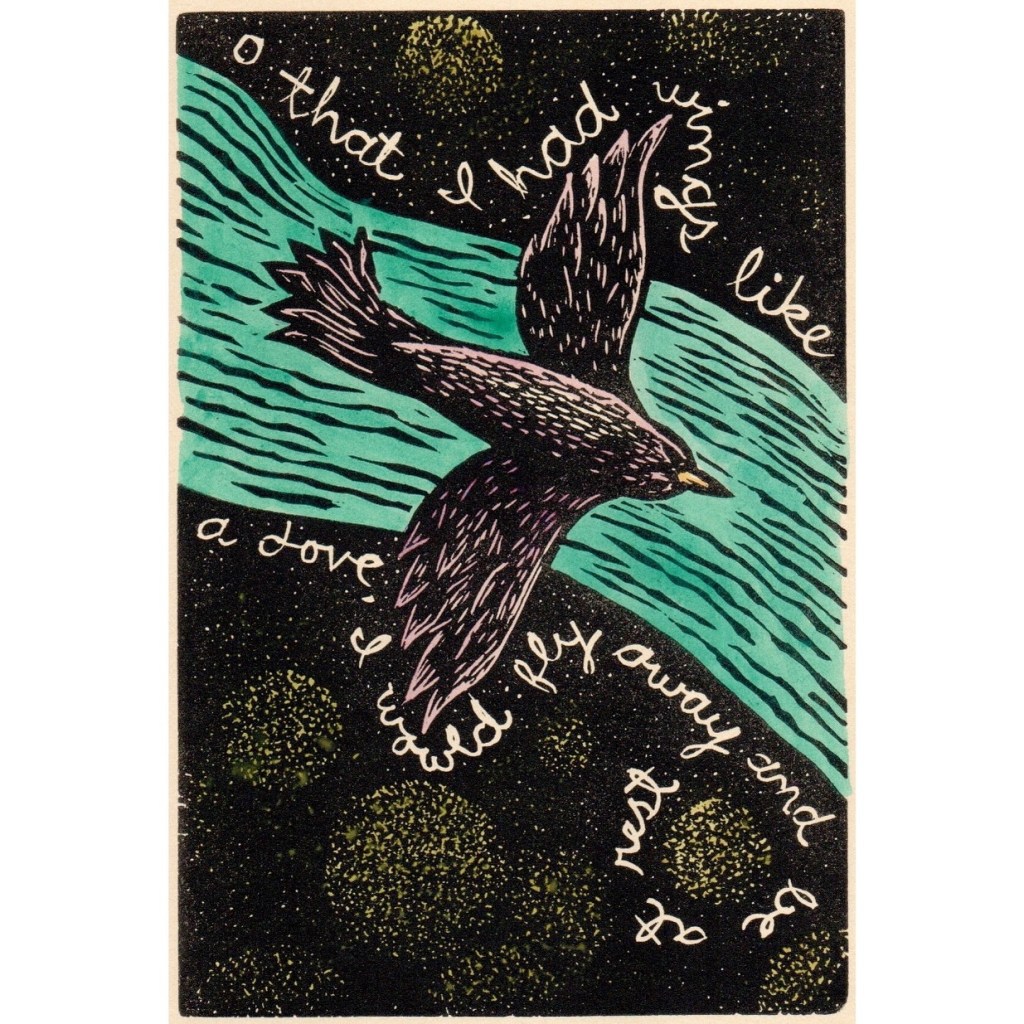
I said. O for the wings of a dove,
that I might fly away and be at rest.
I yearn to flee to the mountains,
to make my dwelling in the wilderness. . .

I cast my burden on you, O God,
and you will sustain and encourage me.
I will call from the midst of my groaning,
you will redeem me to healing and peace. . .

Your arms are wide and welcoming,
in your presence we are relaxed,
and feel most strangely at home.

~ Jim Cotter, based on Psalm 55

————-

Listening Lord,
listen now.
Speaking God,
speak to me now.
I am crushed by fear,
weighed down with worry,
with no sign of relief in sight.

I am heart-sick;
death-dreading;
flung into a nightmare world.
Hunted.
Hounded.
Lost in a labyrinth of death.

If I could fly away, Lord;
make for the skies like a bird;
I’d be off in a moment—
off to some far-flung Heaven
beyond the reach of this hell.

Here I am,
dreaming of escape
while cities burn;
the innocent suffer;
as evil spins its web
around the world—
an encircling darkness;
a pall over every living thing. . .

In distress,
I open my heart to You, Lord.
I pour out its treasure
into Your open hands—
until fear subsides
and my spirit rests.

I take comfort in the knowledge
that this suffering will one day end;
that evil will not have the final word.

Come quickly, Lord Jesus.
All my hope is in You.

~ Smith & Wilt, based on Psalm 55

Art of Kreg Yingst

The Deal is Off!

Essay By Dan

It has been my observation while reading the Book of Hebrews, the author has gone to great lengths to relate the importance of the last supper to the old and new covenant. Now let us couple the message from the Book of Hebrews on the covenant with events that occurred during the Last Supper. We see in Matthew and Luke that Jesus explained to the disciples why He was going to be nailed to a cross. During that discussion, He took them right to the blood of the covenant and its purpose therein.

In Matthew we read – “While they were eating, Jesus took bread, he broke it, and gave it to his disciples, saying, ‘Take and eat; this is my body.’ Then he took a cup and he gave it to them, saying, ‘Drink from it, all of you. This is my blood of the covenant, which is poured out for many for the forgiveness of sins. I tell you; I will not drink from this fruit of the vine until that day when I drink it new with you in my Father’s kingdom.’ ” (Matthew 26:26-29 paraphrased)

At the Last Supper, Jesus carefully explains the spilling of his blood initiates the new covenant (atoning ransom sacrifice for our sins), this ransom message is noticeably clear in Matthew. Jesus presents himself as both the high priest (mediator) offering the sacrifice and the sacrifice himself.

In Luke, we read — After taking the cup, he said, “Take this and divide it among you. For I tell you I will not drink again from the fruit of the vine until the kingdom of God comes.” And he took bread, gave thanks, broke it, and gave it to them, saying, — This is my body given for you; do this in remembrance of me. This cup is the new covenant in my blood, which is poured out for you (Luke 22: 17-20 paraphrased).

Every time we partake in Communion, we hear the message specifying why we take the cup: “This cup is the new covenant in My blood which is poured out for you for the forgiveness of sins” You are hearing the explanation from Jesus of why He had to die. Communion is part of the definition for a new covenant with God, you violated the old covenant, you deserve to die. Jesus made a new deal for us. Jesus implies — I spoke to my Father, I am going to die (ransom sacrifice) in your place, then my Father will be glorified, and my followers will be redeemed forever.

When I ponder on the implications of communion, I think that Jesus is saying — every time you come to that table, I want you to remember that you are in fellowship with My Father, not because of anything that you have done, but because of what I have done. I died in your place to fulfill the curses that should have fallen on your head. I died the death of a covenant-breaker, even though I was the one who was faithful to the covenant so that all you covenant-breakers who believe on Me, who trust in Me, who have faith in Me alone for your salvation, might come into fellowship, reconciled with God.

Final thoughts – the author of Hebrews is encouraging his Jewish readers to not look back to the old covenant rituals as their way into fellowship with God. The old rituals mean nothing apart from Jesus. Do not look at your works, your service, your status, your reputation, your church job title; do not look at anything but Jesus for your reconciliation with God. Why? If we distance ourselves from the ransom and resurrection of Jesus, inserting our works as proof of worthiness into the formula, there is no reconciliation. The deal is off – the impact of the new covenant has been rendered impotent by our feeble proof!

I choose Jesus.

How Firm a Foundation 

“How firm a foundation, ye saints of the Lord,
Is laid for your faith in His excellent word!
What more can He say than to you He hath said,
To you who for refuge to Jesus have fled?

“Fear not, I am with thee, O be not dismayed,
For I am thy God, and will still give thee aid;
I’ll strengthen thee, help thee, and cause thee to stand,
Upheld by My righteous, omnipotent hand.”

“When through the deep waters I call thee to go,
The rivers of sorrow shall not overflow;
For I will be with thee, thy troubles to bless,
And sanctify to thee thy deepest distress.”

“When through fiery trials thy pathway shall lie,
My grace, all sufficient, shall be thy supply;
The flame shall not hurt thee; I only design
Thy dross to consume, and thy gold to refine.”

“E’en down to old age all My people shall prove
My sovereign, eternal, unchangeable love;
And then, when grey hairs shall their temples adorn,
Like lambs they shall still in My bosom be borne.”

“The soul that on Jesus hath leaned for repose,
I will not, I will not desert to his foes;
That soul, though all hell should endeavor to shake,
I’ll never, no, never, no, never forsake!”

The author of this beloved hymn remains unknown.

O’Toole and Mr. Foreman

One morning when O’Toole woke up, he heard a clatter outside.   He jumped out of bed and ran to the window. Across the street there was an empty lot with a high fence around it. He had looked at this empty lot many times but there was never anything very interesting in the lot. But today it was different.

From his bedroom window O’Toole could see a great big steam shovel digging in the dirt.  He could see the steam shovel dumping the dirt into big trucks.   Then he saw dump trucks that were full of dirt leaving the lot.  More empty trucks were coming into the lot.  He also saw a Workman going back and forth.  The workmen were moving things around.  The workmen were stacking up bricks. All kinds of interesting things were happening across the street.  O’Toole could see it all from his bedroom window.

O’Toole was busy watching the steam shovel, the dump trucks, and the workmen.  He did not notice his mother calling him.

O’Toole’s mother said to O’Toole — What are you watching out your window?

O’Toole answered – I am looking at the dump trucks in the empty lot across the street.

O’Toole’s mother said – Goodness, you’re not dressed yet. We need to get you dressed and downstairs. You need to eat some breakfast. The machines are building a nice new building on that empty lot. Let us get dressed so you can go downstairs.  Then you can watch them while you play.

After breakfast O’Toole ran back up to his bedroom. He opened the window so he could hear all of the noise. Clang bang boom roar. It was so exciting.  He watched the steam shovel dig deep into the ground. He watched the dump trucks rumble in and wait.  The steam shovel filled them up with all that fresh dirt. He watched the dump trucks drive out the lot.  They went way down the street. O’Toole was very happy. But then his mother came into O’Toole’s room.

His mother said — O’Toole you can’t stay in your room all day. It’s time for you to go outside into the sunshine and play with the other children.

O’Toole said — OK mother, I can do that. I’ll watch the machines from downstairs on the porch.

O’Toole went downstairs and sat on his porch but he could not see past the big fence. Guess what he did.  He looked both ways and then ran across the street to get closer to the fence.

O’Toole said — I still cannot see the steam shovel. I cannot see the dump trucks. I cannot see the workman. All I can see is a high fence.

O’Toole ran to the gate where the big trucks were going in and out of the empty lot. He could see now. Then a man came to him and stood right in front of him.  Oh My!

Mr. Foreman said – Please go away little boy. It’s not safe for you to be around here. You cannot stay here.

O’Toole said– but I’m so little. I can’t see over your big fence. I want to see the machines and the men doing their work.

O’Toole started praying that God would give him a place where he could see all the activity and be safe.

He looked at the fence and looked for a place where he could peek under the fence. But that did not work. Mr. Foreman came back.

Mr. Foreman said — Little boy you are still not in a safe place. Please go home. You cannot stay here.

O’Toole looked around and prayed again for God to give him a place that was safe so he could watch the machines.  He found an old drainpipe by the fence and stood on top of that drainpipe. But that did not work. He found an old box and stood up on top of that box. But that did not work. Then Mr. Foreman came back again.

Mr. foreman said — Little boy you really need to go home. You cannot climb here. You cannot watch from here.  You need to be where it is safe. You are so small. It would be very easy for my men to not see you and then something bad could happen. Please go home.

O’Toole prayed again for God to give him away to watch that would be safe.  Then an idea came to O’Toole.  I will go home and get my drill.  I will make a hole in the fence where it’s safe.  Then I can watch all of the work getting done. So, O’Toole went home and got his drill.  He came back to the fence and drilled the hole. Once again Mr. Foreman came by to the place where O’Toole was standing.  His concern for O’Toole’s safety was showing on his face.

Mr. Foreman said — Little boy what are you doing now?

O’Toole said — I have drilled the hole in the fence so that I can watch safely.

Mr. Foreman replied — That’s a very good idea little boy.   Please let me help you out.

Mr. Foreman walked away to his pickup truck.  He came back with a big drill.  Mr. Foreman drilled a really big hole in the fence.  Now O’Toole could easily watch the men work. It was safe. Mr. Foreman was happy.  O’Toole was happy.

Then one of O’Toole’s friends came by and wanted to look through the hole at the same time. Mr. Foreman came back with his drill.  He made another hole in the fence for O’Toole’s friend. Then Mr. Foreman made several holes in the fence so that many people could watch what was going on safely.

Mr. Foreman said to O’Toole — Little boy, your prayer was answered. God told me to make a way for you to be able to see things safely. Now we have done that. It is a good day.  O’Toole wondered how Mr. Foreman knew about the prayer.  O’Toole asked his mother about prayer.

O’Toole’s mother said – God always hears our prayer.  God can talk to anyone to get things done.  He told Mr. Foreman to drill the hole and help you be safe.  I am glad you were praying.  God answered.

The End.

Written by Ruth Liebers and Lillian Rothenberg, published in Humpty Dumpty Childrens Magazine, October 1955.  Adapted for ShalomTalk by Dan