The Ransom Death

Essay by Dan

It has been my observation while pouring through the Book of Hebrews there is an interesting linkage between the mediator role and the ransom payment. For example, we read – He is the Mediator of the new covenant, by means of death, for the redemption of the transgressions under the first covenant, that those who are called may receive the promise of the eternal inheritance –now that he has died as a ransom to set them free from the sins committed under the first covenant (Hebrews 9:15).

The central purpose of Jesus as our mediator for sin is found in the interesting phrase “by means of death, for the redemption of the transgressions under the first covenant.” This phrase defines the basis and expression of Christ’s mediatorship in the new covenant as His unwarranted (Jesus had no sin) sacrificial death (Jesus stepped into our place with a ransom for our sin). Therefore, His sinless payment of the ransom and the promises of the new covenant emerge with unmistakable power and victory.

God has been nurturing and growing the Israelites for eons. He was passionately protective of them. Furthermore, we note — Jesus bought (purchased with his ransom) all the sins committed (by Israel, God’s chosen people) under the first covenant. He bought every sin committed by each individual son and daughter of Abraham with his sacrifice. We are wise to notice a key element of the pro bono new covenant implemented by a gracious God that extended this ransom over the gentiles. Jesus explained His death just before His crucifixion; both Matthew and Mark documented Jesus citing a phrase from Exodus 24;”this is the blood of the covenant.” Selah!

Contrasting the Old Testament rituals with the work of Jesus leads us to understand the old ways will never impart everlasting life with the one true living God. In Hebrews 6:1 we find clear affirmation; the old school rituals lead to death. The new covenant (replacement for the old rituals) sets us perfectly free from any need to engage in such things. I think the extensive discussion about the blood of Christ in the Book of Hebrews is designed to calm the Jewish conscience and leave them ready to embrace the eternal inheritance provided by the new covenant (see Hebrews 6:12).

We know from Luke and from Paul the importance of the Jeremiah 31 phrase; “this is the new covenant in my blood.” It was as if Jesus was saying — If you want to understand the covenant, you need to understand that My death and resurrection is the event that delivers the covenant promises prophesied hundreds of years earlier through Jeremiah, Isaiah, Ezekiel, and Moses. My death brings a resurrection through those promises. My death unlocks your heart. This is my gift as mediator of the new covenant.

As the mediator, He is paying for the penalty of sin and buying back those sins committed by all those who believe in Him as Savior and choose to walk with God. This begs the question — is there any possibility of someone saying, “Well, that is nice that Jesus has done that, but I am going to find my path to God – on my own.” Our response? “Huh?” How did you decide on your defense? How did you present your case to Elohim? What was his response? Have you appealed your case? To whom? How is that working out for you? There is only one path to the Father. Jesus said, of himself – “I am the way, the Truth, and the Life. No man comes unto the Father but by Me.” (John 14:6)

The deeper truth – The ransom death is intense, draconian, and brutal. Yet, the ransom is embedded in the message of our salvation. It is the cornerstone of God’s unconditional love for us. His ransom death paid the penalty for all sin; do you know of any other way for that ransom to be paid? I think not. Only the death of the Mediator can clear the debt. Only a perfect offering presented in the heavenly temple can adjudicate our sin. There is no other path possible. None. Nada.

I choose Jesus.
The Game Changer

Essay By Dan

While reading Hebrews 9:24-25, I observed a few pithy comments concerning the Mediator entering the Sanctuary in Heaven. The author of Hebrews writes — Christ did not enter a sanctuary made with human hands that was only a copy of the true one; he entered heaven itself, now to appear for us in God’s presence. Nor did he enter heaven to offer himself again and again, the way the High Priest enters the Most Holy Place every year with blood that is not his own (Hebrews 9:24-25).

One of the underlying assumptions in the Book of Hebrews is — we are estranged from God because of sin — there needs to be mediation to implement our reconciliation with the Father. When we think of the mediator, we should focus on our reconnection with God. This reconnection happens through Jesus as our: Prophet (foreknowledge concerning our need – Isaiah 42:1), Priest (adjudication of our sin and reconciliation – Hebrews 5:10); and King ( submitting our heart to the authority of Jesus – John 12:15).

Hebrews 9:24-28 tells us there is only one mediator ever existent who can remove our sin and that we shall not look to anything else; we shall not look to our own works; we shall not look to the imperfect temple in Jerusalem which existed in the Old Covenant because we now live in the time of the New Covenant where the one true living mediator has established operations in the heavenly temple.

But there is more to this story. Jesus is the ultimate High Priest. All through the Book of Hebrews the author explains how Jesus is superior and the only realistic hope of salvation. With Jesus, there is no need to return to the priestly sacrifices of the Old Testament. When Jesus came as High Priest (the Messiah), he went to the greater and perfect tabernacle in Heaven. He did not enter the heavenly temple with the blood of critters; He entered the heavenly temple presenting his own blood, redeeming all of us with his perfect offering. With the old covenant, the blood of goats and bulls (critters) only sanctified us to be outwardly clean. The blood of Christ (through the eternal Spirit) offered himself unblemished to God. He cleansed our internal consciences from the acts that lead to death so that we may repent and serve the one true living God in grace and in truth (Hebrews 9:11-14 paraphrased). Our peace is the product of the unappeasable sorrow caused by His death and uncontrollable joy caused by His resurrection. Jesus is our righteousness.

Jesus did not enter an earthly sanctuary (a copy of the true one); he entered heaven itself, to be our mediator in God’s presence. He did not enter heaven’s temple to offer himself multiple times, the way the Jewish High Priest does every year on earth. But he appeared once in the heavenly temple, for all time, to negate all sin by the sacrifice of himself. Just as Adam’s sin conferred sin and judgement to the world, so the blood of Jesus removes the sins of the world. Jesus offered himself as a global solution of reconciliation for the global problem of sin present in all of us. Soon, Jesus will appear a second time to implement the plan promised to all Christians. This plan defines our extraction out of our current existence to our forever existence (Hebrews 9:24-28 paraphrased).

The deeper truth is – day after day, the religious man stands and performs his religious duties; day after day, he offers the same tired works (sacrifice). He gradually learns this earthly sacrifice will never earn his place in heaven. The old covenant law will never change our heart, it only reminds us of our failures.

Then enters Jesus — the mediator prepares us so the Holy Spirit can write the law on our heart. This action by God retools our thinking, needs, inclinations, desires, and our focus. The mediator is the ultimate Game Changer. Jesus and the Holy Spirit reconstruct us to live forever. Selah.

I choose Jesus.

A Mighty Fortress

A mighty fortress is our God,
a bulwark never failing;
our helper he, amid the flood
of mortal ills prevailing.
For still our ancient foe
does seek to work us woe;
his craft and power are great,
and armed with cruel hate,
on earth is not his equal.

Did we in our own strength confide,
our striving would be losing,
were not the right Man on our side,
the Man of God’s own choosing.
You ask who that may be?
Christ Jesus, it is he;
Lord Sabaoth his name,
from age to age the same;
and he must win the battle.

And though this world, with devils filled,
should threaten to undo us,
we will not fear, for God has willed
his truth to triumph through us.
The prince of darkness grim,
we tremble not for him;
his rage we can endure,
for lo! his doom is sure;
one little word shall fell him.

That Word above all earthly powers
no thanks to them abideth;
the Spirit and the gifts are ours
through him who with us sideth.
Let goods and kindred go,
this mortal life also;
the body they may kill:
God’s truth abideth still;
his kingdom is forever!

Author: Martin Luther, born at Eisleben, Nov. 10, 1483; entered the University of Erfurt, 1501 (B.A. 1502, M.A. 1503); became an Augustinian monk, 1505; ordained priest, 1507; appointed Professor at the University of Wittenberg, 1508, and in 1512 D.D.; published his 95 Theses, 1517; and burnt the Papal Bull which had condemned them, 1520; attended the Diet of Worms, 1521; translated the Bible into German, 1521-34; and died at Eisleben, Feb. 18, 1546.

Translator: Frederic Henry Hedge D.D.

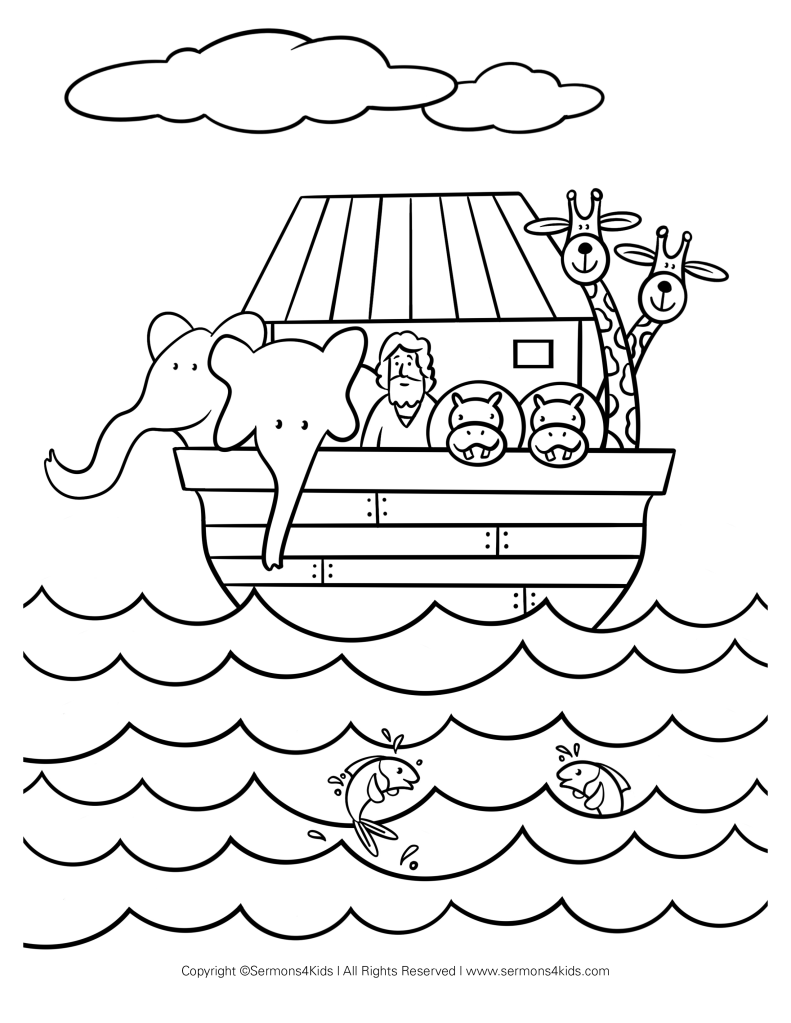
Noah and the Ark

Once upon a time, there was a man named Noah.

Noah was a good and righteous man who always did what was right, and this pleased God.

However, not everyone in the world was like Noah.

One day, God looked down at the world and saw that the people were being very wicked and not taking care of the earth. God decided to do something about it.

God told Noah to build a big boat called an ark and then gather two of every kind of animal, one male and one female, to bring with them onto the ark.

God explained that he was going to send a great flood to cleanse the earth, and the ark would keep Noah, his family, and all the animals safe.

Noah and his family toiled away for many years, working really hard to build the ark.

They made sure to follow God’s instructions and made the ark very strong. They also collected enough food for themselves and the animals, which they would need during the flood.

Once the ark had been completed, Noah, his family and all the animals went inside.

As soon as Noah and his family were safely in the ark, it began to rain. And then it rained and rained for forty days and forty nights.

Eventually, the floodwater covered the entire world, but the ark floated on the water keeping everyone dry.

Being cooped up in the ark like that, it must have felt as if the rain was going to last forever, but Noah and his family trusted God. They took care of the animals and waited for the rain to stop.

After forty days, the rain did finally stop, and so Noah sent out a dove to try and find dry land. The dove quickly returned, but after seven days, the dove was sent out again. This time the dove came back with a freshly plucked olive leaf in its beak, which meant there must be dry land nearby.

Noah and his family were so happy, they knew the flood was almost over.

When God told them it was time to leave the ark, they opened the doors. Noah’s family and the animals stepped out onto dry land.

They were happy and grateful to God for saving them.

God then made a promise to Noah that He would never send such a big flood again.

As a sign of His promise, God put a beautiful rainbow in the sky. And from that day on, whenever it rains and a rainbow appears, people remember God’s love and faithfulness.

Proverbs 31:10-31

Hymn to a Good Wife

10-31 A good woman is hard to find,
    and worth far more than diamonds.
Her husband trusts her without reserve,
    and never has reason to regret it.
Never spiteful, she treats him generously
    all her life long.
She shops around for the best yarns and cottons,
    and enjoys knitting and sewing.
She’s like a trading ship that sails to faraway places
    and brings back exotic surprises.
She’s up before dawn, preparing breakfast
    for her family and organizing her day.
She looks over a field and buys it,
    then, with money she’s put aside, plants a garden.
First thing in the morning, she dresses for work,
    rolls up her sleeves, eager to get started.
She senses the worth of her work,
    is in no hurry to call it quits for the day.
She’s skilled in the crafts of home and hearth,
    diligent in homemaking.
She’s quick to assist anyone in need,
    reaches out to help the poor.
She doesn’t worry about her family when it snows;
    their winter clothes are all mended and ready to wear.
She makes her own clothing,
    and dresses in colorful linens and silks.
Her husband is greatly respected
    when he deliberates with the city fathers.
She designs gowns and sells them,
    brings the sweaters she knits to the dress shops.
Her clothes are well-made and elegant,
    and she always faces tomorrow with a smile.
When she speaks she has something worthwhile to say,
    and she always says it kindly.
She keeps an eye on everyone in her household,
    and keeps them all busy and productive.
Her children respect and bless her;
    her husband joins in with words of praise:
“Many women have done wonderful things,
    but you’ve outclassed them all!”
Charm can mislead and beauty soon fades.
    The woman to be admired and praised
    is the woman who lives in the Fear-of-God.
Give her everything she deserves!
    Adorn her life with praises!