The Passover

Essay by Dan

It has been my observation, while reading the Book of Exodus, the Hebrews were compelled to provide backbreaking labor in the brickyards of Egypt; but, despite the hardship, they prospered. They became a large nation with no way to loosen the shackles that held them – from that situation — our story begins.

The Book of Exodus opens with God looking upon the Hebrews. The Lord said to Moses– I have … seen the misery of my people in Egypt. I have heard them crying out because of their slave drivers, and I am concerned about their suffering. So, I have come down to rescue them from … the Egyptians and to bring them up out of that land into a good and spacious land, …. So now, go. I am sending you to Pharaoh to bring my people the Israelites out of Egypt (Exodus 3:7-10 paraphrased).

Then a battle ensued, a battle between idols and the one true living God. Our God pitted Himself against the idolatry of Egypt with plagues. Each plague originated from the one true living God. The plagues were directed against the idols of Egypt. First, the sacred Nile was turned to blood; then there were frogs, lice, then flies that swarmed over the land; the livestock sickened and died; boils broke out on both man and beast; hail and locusts devastated their crops; then darkness enveloped them for three days. God’s message was straight forward. The plagues demonstrated to the Hebrews their redemption and emancipation was in progress; not because of any merit within them, but solely by His sovereign grace and power. The demonstration culminated with the last plague — the death of the firstborn (implied from Exodus chapters 7-13).

God said it would be a night that they would never forget. Today if you go into the home of most Orthodox Jewish families, you will find the Passover on their calendar. After all these years, Passover is still remembered. This is the day that God delivered His own. The Hebrews in Egypt were asked to select a lamb; they were to slay it and eat it for dinner accompanied by unleavened bread and bitter herbs. The blood of that lamb was to be put outside on the doorposts of their home. On that night, the death angel arrived. He did not take time to determine if people on the inside of the house were praying. He did not ask if they had joined the right political group. He did not examine their walk with God. He did not inquire if they were Hebrews. The only thing he checked for was blood on the doorpost. When he saw the blood, he passed over the house. If the blood was not present on the doorpost, the firstborn in that unprotected house was killed (implied in Exodus 12:1-12).

Passover was judgment from Almighty God upon a sinful nation and a sinful people. The firstborn who lived through that night knew that they were redeemed by the blood of a lamb. The single thing that enabled God’s redemption was blood. That night the Hebrews ate the Passover and were redeemed by the lamb’s blood. They consumed the lamb, and they consumed unleavened bread. Does this sound like a precursor to Communion? We have the body of Jesus (lamb, Bread) and blood of Jesus (lamb’s blood). Is Communion a reminder of Passover? I think it is (implied in Luke 22:14-19). There is more…

Do you remember my previous essay on eagle wings? “Ye have seen what I did unto the Egyptians, and how I bore you on eagles’ wings and brought you unto myself” (Exodus 19:4). Isaiah 40:31 says “Those who hope in the Lord will renew their strength. They will soar on wings like eagles; they will run and not grow weary; they will walk and not be faint.”  Deuteronomy 32:11 says — “As an eagle stirs up her nest, flutters over her young, spreads abroad her wings, taketh them, bears them on her wings.” We are lifted-up high; we go where no ordinary man can go; we pass over trouble using a transport mode that no ordinary person can use. Eagle Wings.

I choose Jesus.

Under His Wing

Essay by Dan

It was my observation — there was a young woman named Ruth; she left the land of Moab and traveled to the land of Israel because she trusted God. Boaz, a wealthy man in Israel said to her — “May the Lord repay you for what you have done. May you be richly rewarded by the Lord, the God of Israel, under whose wings you have come to take refuge” (Ruth 2:12). You may recall from Psalm 91:4 our journey is described as being “covered with His feathers” and “under His wings you will find refuge.” Deuteronomy 32:11 describes the protective wings as eagle wings. What a picture of God’s shelter.

Sometimes we are under the wings, sometimes we are on eagle wings. When God leads the Hebrews out of Egyptian darkness into the promised land, we find it described as an airlift, by eagles’ wings. God says to the Hebrews in Exodus – “You yourselves have seen what I did to Egypt, and how I carried you on eagles’ wings and brought you to myself. Now if you obey me fully and keep my covenant, then out of all nations you will be my treasured possession. Although the whole earth is mine, you will be for me a kingdom of priests and a holy nation. These are the words you are to speak to the Israelites.” (Exodus 19:4-7). Moses went back and summoned the elders of the people and told them what God said. The Hebrews responded, “We will do everything the Lord has said.” Moses brought their answer back to the Lord. (Paraphrased from Exodus 19:8).

For a moment, consider using two utterly separate modes of travel through our life. Consider the difference between a rowboat and an aircraft. You cannot travel with one foot in a rowboat and the other foot in an aircraft — it is impossible. Yet today, as a matter of faith, people are trying to live by a blend of law and grace. I am not saying you are, but if you are not clear about the nature of your walk with God, accidentally trying to live by your good works, may I suggest to you there is a better way – an easier way that is much less stressful. There is a way that takes us to the ‘eagle wing’ and places us in the center of the one true living God’s world.

J Vernon Magee tells us – “The Law demands; grace gives. The Law extracts; grace bestows. The Law says do; grace says believe. The Law says work; grace says trust. The Law growls, pronouncing trouble; grace invites, announcing a respite. The Law decries all of us; grace pulls us into safety. The Law reveals the sovereignty of God then grace reaches out in power lifting man up on eagle wings.

Paul says – The things Moses and the prophets witnessed all those years has happened. The God-setting-things-right that we read about has become Jesus-setting-things-right for us. And not only for us, but for everyone who believes in him. For there is no difference between us and them in this. Since we have compiled this long and sorry record as sinners (both us and them) and proved that we are utterly incapable of living the glorious lives God wills for us, God did it for us. Out of sheer generosity he put us in right standing with himself. A pure gift. He got us out of the mess we were in and restored us to where he always wanted us to be. And he did it by Jesus Christ. (implied Romans 3:21-24 MSG)

Paul continues – God sacrificed Jesus on the altar of the world to clear that world of sin. Having faith in his resurrection places us in the clear. God decided on this course of action in full view of the public—to set the world in the clear with himself through the sacrifice and resurrection of Jesus, finally taking care of the sins he had so patiently endured. This is not only clear, but it is now—this is current history! God sets things as they belong. He makes it possible to live in his way. (implied Romans 3:25-26 MSG).

It is by His mercy, it is by eagles’ wings, it is by His grace. Embrace it! Let Easter happen to you.

I choose Jesus.

The Blessed Name

There is no name so sweet on earth,

  No name so sweet in heaven,

The name before His wondrous birth

  To Christ the Saviour given.

O Jesus, by Thy matchless name,

  Thy grace shall fail us never;

To-day as yesterday the same,

  We’ll bless Thy name forever.

For there’s no name ear ever heard

  So dear, so sweet as Jesus.

We love to sing of Christ our King

  And hail Him, blessed Jesus.

  —George W. Bethune (1805-1862)

Jesus is Tempted in the Wilderness

We cannot see God, but we know he is always near us. He helps us and takes care of us. He always wants us to do the right things so we will be happy. He wants us to come live with him when we die.

We cannot see Satan, but he is alive too. He is very bad. He tries to get us to do bad things. He does not want us to go to heaven when we die. Heaven is a happy place where God lives. Satan wants us to go to a bad place called hell. No one is ever happy in hell because God is never there.

Temptation:

Sometimes we want to do the wrong thing. Wanting to do the wrong thing is called “temptation.”

Sometimes we know to do something good, but we want to just forget about it and not do it. When we feel like not doing something that we know is good that is also temptation.

Temptation is when bad and wrong things look really good to us. Satan tempts us. He hates it when we are good, so he tries to make bad things seem good to us. Sometimes he makes them look so good that we forget what God says and just do the bad thing.

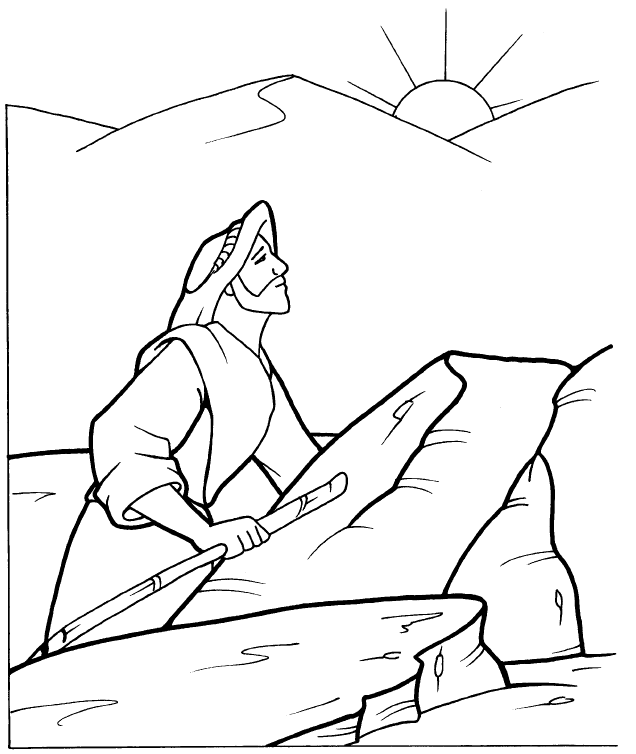
After Jesus was baptized, he went away to the desert to be alone. He decided that he wanted to pray and think about God for 40 days. Jesus did not want to be distracted by anything, so he fasted.

To fast means to not eat so that even our bodies make us think about God every time we feel hungry. Jesus fasted and did not eat for 40 days when he was in the desert.

Satan did not like it because Jesus only thought about God. Satan hated it that Jesus was so good all the time. He decided to tempt Jesus and try to make him do bad things. Satan came to Jesus and tempted him in three ways.

Temptation 1: Satan knew Jesus was really hungry, so he tempted Jesus to use his powers in a selfish way all for himself. Satan said, “If you are really the Son of God then use your special powers to turn these stones into bread.”

Jesus was hungry but he knew that God wanted him to only use his special powers to help people. His power was not just for feeding himself! Jesus wanted to do the right thing. He knew the best way to answer Satan was to use God’s words. Jesus had memorized a lot of scriptures, so he knew exactly which scripture to say to Satan. He said this verse from the Bible, “Man does not live on bread alone, but on every word that comes from the mouth of God.”

Temptation 2: Next, Satan took Jesus to Jerusalem to the temple. Both Jesus and Satan knew that the temple was a special place to God.

They stood at the highest point of the temple. Satan wanted to get Jesus to doubt God’s power. He told Jesus that he should give God a test to see if his power worked. Satan told Jesus to jump off the temple and see if God’s angels would catch him.

But Jesus did not need to give God a test. Jesus already knew that God’s power was stronger than anything in the world. Jesus told Satan another Scripture from God’s word. “Do not put the Lord your God to the test.”

Temptation 3: You would think that Satan would have learned his lesson, but he REALLY wanted Jesus to mess up. Maybe Satan thought, “If only I can get Jesus to do things MY way, then I will be more important to him than God is.”

So, Satan had one more thing he could do to tempt Jesus. Maybe this time he could get Jesus to sin. Satan took Jesus to the top of a very high mountain. They could see the whole world from the top of the mountain.

So, Satan said, “You say you love all the people of the world. You say you want them to go to heaven. How about a deal? I will help all the people of the world go to heaven if you will just do one simple thing. All you have to do is to bow down and worship me instead of God.”

Do you think Jesus gave in to this temptation? No! Jesus had had enough. He told Satan to go away. Of course he would never worship Satan! Jesus loved God. He would only worship God. Jesus quoted from the Old Testament one more time, “Worship the Lord you God, and serve him only.”

Then Satan left Jesus. Angels came and helped take care of Jesus after that.

Do you think Satan gave up trying to tempt Jesus? No, he did not give up. Over the next 3 years Satan tried again and again to tempt Jesus but Jesus never did wrong.

God understands that temptation is very difficult. It was even hard for Jesus.

Sometimes we are tempted to do the wrong thing too. God understands Satan’s sneaky tricks and he can help us say “no” to temptation. We need to remember God’s true words just like Jesus did.

Scripture Reference: Matthew 4:1-11

1 Corinthians 14:34-40

34-36 Wives must not disrupt worship, talking when they should be listening, asking questions that could more appropriately be asked of their husbands at home. God’s Book of the law guides our manners and customs here. Wives have no license to use the time of worship for unwarranted speaking. Do you—both women and men—imagine that you’re a sacred oracle determining what’s right and wrong? Do you think everything revolves around you?

37-38 If any one of you thinks God has something for you to say or has inspired you to do something, pay close attention to what I have written. This is the way the Master wants it. If you won’t play by these rules, God can’t use you. Sorry.

39-40 Three things, then, to sum this up: When you speak forth God’s truth, speak your heart out. Don’t tell people how they should or shouldn’t pray when they’re praying in tongues that you don’t understand. Be courteous and considerate in everything.