Heart Focus

It has been my observation, when we pray, it should not be routinely structured to get something from God. Rather, prayer is a way to connect with Him and realign our hearts with His heart, His will on all things that matter. Prayer is an especially important tool during our walk with God. Prayer should not be taken lightly. Like any relationship, if you do not spend time with that person the relationship will eventually suffer. Prayer is a way for us to spend quality time with God. It is a way to deeply connect with Him and purge our mind of earthly things. When we pray, we open our hearts to Him — He works in us and through us. Prayer also helps us to build our relationship with God – focused on Him.

James 4:8 tells us — Draw near to God and He will draw near to you (NIV). I can recall multiple times in my own life moments in prayer where I pressed in and felt His peace override all understanding. Prayer helps us see life through a heavenly lens.

Philippians 4:6-7 says — Be anxious for nothing, but in everything by prayer and supplication, with thanksgiving, let your requests be made known to God; and the peace of God, which surpasses all understanding, will guard your hearts and minds (NIV).

Prayer is important because it positions us to receive God’s peace during life’s hardest moments, prayer helps me stay focused on what is close to God’s heart! He is the One who can help you focus, find peace, comfort, healing, strength, purpose and so much more. God’s wisdom compels us to pray on regular basis about everything in our life (implied in James 1:5). Please understand, prayer for me is more than a formal, head bowed experience, it is daily chatter, all through the day. Talk with him like we talk with our close friends. Success, failure, opportunities, mistakes, heartache, little pleasures – these are the substance of a rich relationship.

Prayer is a gift; Paul tells us — pray in the Spirit on all occasions with all kinds of prayers and requests. With this in mind, be alert and always keep on praying for all the Lord’s people.” (Ephesians 6:18).

Waiting for a better time or better location to pray is counterproductive. We are told to Pray continually (1 Thessalonians 5:17). We offer praise for the good stuff and we ask for help when needed. James asks — Is anyone among you in trouble? Let them pray (James 5:13).

Our happenings are all good reasons to pray. Paul says — Be joyful in hope, patient in affliction, faithful in prayer (Romans 12:12). Dig deep into the heart of Wisdom, get quiet. Get humble. Focus. Get it done.

When Jesus prayed for his disciples in John 17, he prayed for those who would believe in him, “that all of them may be one, Father, just as you are in me and I am in you” (John 17:21). Prayer helps us become one with the Father and have the kind of relationship Jesus had with him. When we come into the presence of God, all our interpretation and pretense are gone—there is nothing to hide because he sees everything and knows everything about us.

We are humbled by the realization God’s power, goodness, and how much we need him. And yet, God accepts us as we are—not because he wants us to stay that way, but because he knows that the relationship comes first. As we grow to love him, we choose to become more like him. When we find forgiveness through prayer, God softens our heart and allows us to forgive others. When we experience God’s compassion and mercy, we become much more comfortable sharing the experience with others. When we understand that God’s grace is freely given, we learn to accept God’s love; it transforms our hearts and our actions.

The best thing about prayer is the two-way conversation. This conversation we call prayer has all the components of communication; we talk to God, he listens, he talks to us, we listen. Communication is not communication unless information moves both ways between the two people involved in the event. Please do not deliver a briefing to God, engage in a conversation. Communicate. James 1:5 says – If any of you lacks wisdom, you should ask God, who gives generously to all without finding fault.

I choose Jesus.
Unmerited Grace for All

Written By Dan

It has been my observation that we Christians look to the Bible for lasting meaning and hope; this search allows us to use our reasoning abilities as God intended. The Bible presents the reality of God (implied in Revelation 1:8), who has revealed Himself to all people (implied in Psalms 19:1-2).

The apostle Paul argued this point when he wrote, “since the creation of the world His invisible attributes, eternal power, and divine nature have been clearly seen; being understood through what has been made, so that they are without excuse” (Romans 1:20). This declaration, in which God reveals Himself through nature, is also shown to the heart of every person, for “that which is known about God is evident within them; for God made it evident to them” (Romans 1:19).

John Calvin referred to this as the ‘sensus divinitatis’, which is an innate sense of divinity, an intuitive knowledge that God exists. Calvin wrote, “there exists in the human mind and indeed by natural instinct, some sense of Deity.” He further states, “All men of sound judgment will therefore hold, that a sense of Deity is indelibly engraved on the human heart.” Calvin also wrote, “there never has been, from the very first, any corner of the globe, any city, any household, without religion, [which] amounts to a tacit confession, that a sense of Deity is inscribed on every heart.”

The problem is not with God’s clear revelation, but with the human heart which is rebellious. For those possessed with sinful persistence, they suppress the truth with their unrighteousness (implied in Romans 1:18). These rebels have a sinful heart that ignores God’s grace to pursue earthly passions.

In Romans 1:21-23 Paul wrote — For although they knew God, they neither glorified him as God nor gave thanks to him, but their thinking became futile, and their foolish hearts were darkened. Although they claimed to be wise, they became fools and exchanged the glory of the immortal God for images made to look like a mortal human being and birds and animals and reptiles. (NIV).

God never forces Himself on anyone. People are free to choose whether to accept Him or not. If they reject the gentle nudge from the Spirit of God, he does not render the final judgment upon them right away. Rather, God extends to them an undeserved period of kindness and goodness, regardless of whether they have yielded to grace or continue rebelling (implied in John 3:16). But death brings the period of kindness to closure.

This grace is dependent on God and not the attitude or actions of men. Jesus said of His Father, that “He causes His sun to rise on the evil and the good and sends rain on the righteous and the unrighteous” (Matthew 5:45). Paul affirmed this grace, saying, “In the generations gone by, He permitted all the nations to go their own ways [in rebellion]; and yet He did not leave Himself without witness, in that He did good and gave you rains from heaven and fruitful seasons, satisfying your hearts with food and gladness” (Acts 14:16-17). Here, God’s grace is obvious, Elohim provides what we need. He even blesses the unsaved and unrepentant. His love, mercy, and goodness are extended toward the undeserving entirely because of his earnest goal to see all of us yield to Grace before we die.

Salvation comes to us by grace alone (it is an undeserved gift), through faith alone (adding no works), by Jesus alone (as the only One who saves). Paul wrote, “For by grace you have been saved through faith; and that is not of yourselves, it is the gift of God; not as a result of works, so that no one may boast” (Ephesians 2:8-9). Salvation comes to us via the death, burial, and resurrection of Jesus (implied in Romans 10:9). We deserve death; but grace abounds through the ransom paid by the Lamb of God.

I choose Jesus.

Finding the Path Home

Essay By Dan

It has been my observation from Genesis 3 that we have been rebellious since the beginning. The rebellion started with Adam and expanded to all of us. Then Elohim (God) pushed the reset button on civilization (Noah and the flood) and started fresh with one family. Gradually, after the flood, Elohim introduced rules to live by (Leviticus) – a process of self-regulation that required our attention.

When I read Leviticus, I am struck by the sheer volume and range of trouble we can get ourselves into. Human sin is very destructive. It disfigures our soul, pollutes our mind, and taints our heart with darkness. God’s work in us is impaired, distracted, weakened. Our relationships are fractured, we struggle for power, we become aggressive in our heart, and eventually we become comfortable with evil. Rebellion and self-aggrandizement become our highway to mediocracy. Our sin is invasive; it spreads from our heart to our family – then the rebellion quickly infects the community and creeps into God’s house. The Holy of Holies becomes unclean. How does God feel? I suspect a combination of exasperation and compassion for us. We vandalize his house with our sin, leaving our tags everywhere. His tears form. We leave our trash in heaps at his feet (as we unburden ourselves) and then head straight back into the cesspool. He sighs. He is holy, we are mired in rebellion. Yes, I too am guilty of creating trash heaps.

The ancient story of Israel and Egypt is a story of sorrow when God’s people choose to take ownership of God’s plan and redefine morality to suit their desires. As a result, they became slaves in Egypt. Enter Moses, the Red Sea, the Tabernacle, and the book of Leviticus. Tabernacle operations (defined in Leviticus) was the method where God opened the door to dwell amongst the people with a new leadership plan (sin payments). The tabernacle walls protected our eyes from Elohim’s shekinah light.

You know that sin is infectious. It is easier to continue than stop. The Israelites needed a path that pulled them away from sin, cleared the debt of sin, and opened the door to sustainable operations in God’s presence. This leads us to the reason for animal sacrifice. The sacrifice was first seen in the skins provided by God to Adam and Eve to cover their nakedness (self-awareness of sin); then, as time progressed, sin became much more deplorable. Rampant sin illustrated the need for a new covenant.

I would not find it easy to cut an animal’s throat and watch it die, even if it were necessary to rectify my personal foolishness. Please understand, I am a carnivorous person, killing animals is part of that lifestyle. But this sacrifice thing is different. Watching life (blood) drain into a bowl, a visceral image of the outcome of sin, would be an overwhelming event for me. We (through our sin) accelerate the darkness that tries to crush the world. The impact cannot be overstated; it may not seem like much to yell at your neighbor. Who gets injured? Yet, looking at sin on the global scale, the multiplication factor drives the number of sins towards infinity every moment of every day. The aggregate of our sin grieves God. The old covenant law exposes Lucifer and our weakness. The new covenant is built on grace.

The symbolism of the sacrifice is a physical expression of God’s demand for justice and desire to offer grace. Elohim is justified when he wants people to face the consequences (owning the sacrifice). But, at the same time, he feels compassion for us. So, he accepts the animal’s life as a temporary payment. Consider the impact of the Yom Kippur’s blood offering and the scapegoat (sin removal). This is a precursor for the ransom of Jesus and the Holy Spirit to write Elohim’s precepts on our hearts.

John wrote — God showed his love among us: He sent his one and only son into the world that we might live through him. This is love: not that we loved God, but that HE LOVED US and sent his Son as an atoning sacrifice for our sins. (1 John 4:9-10). His love and sacrifice for us defines our path home.

I choose Jesus.

The Freedom to Give

Essay By Dan

It was my observation while making a survey of Leviticus that Elohim set up a series of rules for the application of sacrifice to address the commission of sin. What I found interesting was the list of problems that require a sacrifice served as a roadmap for Lucifer’s sphere of operations. God chose to define the areas Lucifer uses to draw us into a state of rebellion. God then conveniently provides a path back from each operational area used by Lucifer. The more we understand about Lucifer’s sphere of operation the less effective Lucifer is trying to dismantle our relationship with the one true living God.

Consider the implication of the sacrificial guidelines (see Leviticus 16). The animal being offered had to be perfect. There needed to be a connection between the animal and the person offering the animal for sacrifice. The person offering the animal had to be part of the death process (direct kill or a sanctioned kill by a priest). The person offering the animal knows the sacrifice is only a temporary cover for sin. I think this lays the framework for the death, burial, and resurrection of our perfect ransom — Jesus.

Once per year, the Day of Atonement (Yom Kippur) provides full forgiveness and sin removal at the national level for the Israelites. The high priest presented two male goats; one for a sin offering and the other was released into the wilderness as a scapegoat. The sin offering incurred God’s forgiveness; the released goat provided removal of sin. Humm… Sound a bit familiar?

Jesus functioned as the sin offering (similar to the Yom Kippur). The Yom Kippur scapegoat carried the sins of the people into the desert to be lost for all time. The impact? Our sin is forgotten. I think it is reasonable to view the sacrifice of Jesus as a perfect version of the Yom Kippur. Peter tells us that Jesus carried our sin in his body (implied in 1 Peter 2:24); the author of Hebrews tells us the sacrifice of Jesus caused the permanent removal of our sin (implied in Hebrews 9:8-14).

Let us dig a little more. When I read Exodus, Leviticus, or Numbers; I note a plethora of verses on sacrificial operations. We cannot help but notice the group of people selected to be priests (Hebrew term — Kohanim) during the exodus from Egypt. They were the only ones who were allowed to accomplish the sacrifices and bring the nation closer to God. Aaron was the first priest (Hebrew term — Kohen), gradually his male children became the group of priests (Kohanim) who managed the temple. The Kohanim (priests) were required to clear their own sin first, then they were able to address the sin of individuals, or even the entire nation (Yom Kippur).

The sacrifices offered by the Kohanim (priests) were called Korban (Hebrew term for sacrifice). The Korban was presented in the temple at least three times a day. The Korban (often translated sacrifice) means ‘draws close.’ There were three types of korbans – animal sacrifice, grain offering, and money donations. The desired effect of the Korban was to prepare a path for God to dwell amongst us on a daily basis (Exodus 25:8). The Korban was a constant reminder to us of the areas where Lucifer would attack — his modus operandi. If we want to know how he will move against us (sphere of operation) then we should get familiar with the law. Lucifer’s battle plan is very clearly presented in the law.

The deeper truth – the Korban, in its purest form, brings us closer to God. Jesus chose to offer himself for us as the ultimate Korban. Unlike the animals who do not have a say in their role as the Korban, Jesus offered himself with no pressure from Elohim. Jesus said — Just as the Father knows me, and I know the Father— I LAY DOWN MY LIFE FOR THE SHEEP (John 10:15 paraphrased). He chose to be the sacrifice. Jesus freely gave his life for us. His offering was far better than the Old Testament Korban. His ransom payment was a permanent response for our sin.

I choose Jesus.

The Ransom Death

Essay by Dan

It has been my observation while pouring through the Book of Hebrews there is an interesting linkage between the mediator role and the ransom payment. For example, we read – He is the Mediator of the new covenant, by means of death, for the redemption of the transgressions under the first covenant, that those who are called may receive the promise of the eternal inheritance –now that he has died as a ransom to set them free from the sins committed under the first covenant (Hebrews 9:15).

The central purpose of Jesus as our mediator for sin is found in the interesting phrase “by means of death, for the redemption of the transgressions under the first covenant.” This phrase defines the basis and expression of Christ’s mediatorship in the new covenant as His unwarranted (Jesus had no sin) sacrificial death (Jesus stepped into our place with a ransom for our sin). Therefore, His sinless payment of the ransom and the promises of the new covenant emerge with unmistakable power and victory.

God has been nurturing and growing the Israelites for eons. He was passionately protective of them. Furthermore, we note — Jesus bought (purchased with his ransom) all the sins committed (by Israel, God’s chosen people) under the first covenant. He bought every sin committed by each individual son and daughter of Abraham with his sacrifice. We are wise to notice a key element of the pro bono new covenant implemented by a gracious God that extended this ransom over the gentiles. Jesus explained His death just before His crucifixion; both Matthew and Mark documented Jesus citing a phrase from Exodus 24;”this is the blood of the covenant.” Selah!

Contrasting the Old Testament rituals with the work of Jesus leads us to understand the old ways will never impart everlasting life with the one true living God. In Hebrews 6:1 we find clear affirmation; the old school rituals lead to death. The new covenant (replacement for the old rituals) sets us perfectly free from any need to engage in such things. I think the extensive discussion about the blood of Christ in the Book of Hebrews is designed to calm the Jewish conscience and leave them ready to embrace the eternal inheritance provided by the new covenant (see Hebrews 6:12).

We know from Luke and from Paul the importance of the Jeremiah 31 phrase; “this is the new covenant in my blood.” It was as if Jesus was saying — If you want to understand the covenant, you need to understand that My death and resurrection is the event that delivers the covenant promises prophesied hundreds of years earlier through Jeremiah, Isaiah, Ezekiel, and Moses. My death brings a resurrection through those promises. My death unlocks your heart. This is my gift as mediator of the new covenant.

As the mediator, He is paying for the penalty of sin and buying back those sins committed by all those who believe in Him as Savior and choose to walk with God. This begs the question — is there any possibility of someone saying, “Well, that is nice that Jesus has done that, but I am going to find my path to God – on my own.” Our response? “Huh?” How did you decide on your defense? How did you present your case to Elohim? What was his response? Have you appealed your case? To whom? How is that working out for you? There is only one path to the Father. Jesus said, of himself – “I am the way, the Truth, and the Life. No man comes unto the Father but by Me.” (John 14:6)

The deeper truth – The ransom death is intense, draconian, and brutal. Yet, the ransom is embedded in the message of our salvation. It is the cornerstone of God’s unconditional love for us. His ransom death paid the penalty for all sin; do you know of any other way for that ransom to be paid? I think not. Only the death of the Mediator can clear the debt. Only a perfect offering presented in the heavenly temple can adjudicate our sin. There is no other path possible. None. Nada.

I choose Jesus.

The Game Changer

Essay By Dan

While reading Hebrews 9:24-25, I observed a few pithy comments concerning the Mediator entering the Sanctuary in Heaven. The author of Hebrews writes — Christ did not enter a sanctuary made with human hands that was only a copy of the true one; he entered heaven itself, now to appear for us in God’s presence. Nor did he enter heaven to offer himself again and again, the way the High Priest enters the Most Holy Place every year with blood that is not his own (Hebrews 9:24-25).

One of the underlying assumptions in the Book of Hebrews is — we are estranged from God because of sin — there needs to be mediation to implement our reconciliation with the Father. When we think of the mediator, we should focus on our reconnection with God. This reconnection happens through Jesus as our: Prophet (foreknowledge concerning our need – Isaiah 42:1), Priest (adjudication of our sin and reconciliation – Hebrews 5:10); and King ( submitting our heart to the authority of Jesus – John 12:15).

Hebrews 9:24-28 tells us there is only one mediator ever existent who can remove our sin and that we shall not look to anything else; we shall not look to our own works; we shall not look to the imperfect temple in Jerusalem which existed in the Old Covenant because we now live in the time of the New Covenant where the one true living mediator has established operations in the heavenly temple.

But there is more to this story. Jesus is the ultimate High Priest. All through the Book of Hebrews the author explains how Jesus is superior and the only realistic hope of salvation. With Jesus, there is no need to return to the priestly sacrifices of the Old Testament. When Jesus came as High Priest (the Messiah), he went to the greater and perfect tabernacle in Heaven. He did not enter the heavenly temple with the blood of critters; He entered the heavenly temple presenting his own blood, redeeming all of us with his perfect offering. With the old covenant, the blood of goats and bulls (critters) only sanctified us to be outwardly clean. The blood of Christ (through the eternal Spirit) offered himself unblemished to God. He cleansed our internal consciences from the acts that lead to death so that we may repent and serve the one true living God in grace and in truth (Hebrews 9:11-14 paraphrased). Our peace is the product of the unappeasable sorrow caused by His death and uncontrollable joy caused by His resurrection. Jesus is our righteousness.

Jesus did not enter an earthly sanctuary (a copy of the true one); he entered heaven itself, to be our mediator in God’s presence. He did not enter heaven’s temple to offer himself multiple times, the way the Jewish High Priest does every year on earth. But he appeared once in the heavenly temple, for all time, to negate all sin by the sacrifice of himself. Just as Adam’s sin conferred sin and judgement to the world, so the blood of Jesus removes the sins of the world. Jesus offered himself as a global solution of reconciliation for the global problem of sin present in all of us. Soon, Jesus will appear a second time to implement the plan promised to all Christians. This plan defines our extraction out of our current existence to our forever existence (Hebrews 9:24-28 paraphrased).

The deeper truth is – day after day, the religious man stands and performs his religious duties; day after day, he offers the same tired works (sacrifice). He gradually learns this earthly sacrifice will never earn his place in heaven. The old covenant law will never change our heart, it only reminds us of our failures.

Then enters Jesus — the mediator prepares us so the Holy Spirit can write the law on our heart. This action by God retools our thinking, needs, inclinations, desires, and our focus. The mediator is the ultimate Game Changer. Jesus and the Holy Spirit reconstruct us to live forever. Selah.

I choose Jesus.

Feeding of the Five Thousand

Many people heard about Jesus. They heard that he was a good teacher and helped people to learn more about God. They heard that he could make sick people well. Sometimes big crowds of people would gather to hear Jesus speak.

One time Jesus and his apostles wanted to spend time together away from the big crowds of people. Where could they go to be alone? They decided to get into a boat and sail to the other side of the Sea of Galilee. They could rest and talk together in the quiet of the grassy green hills away from cities and people. So, they sailed across.

The Sea of Galilee is not very big. It is not actually a sea, but it is a lake. The people could see Jesus and his apostles landing the boat on the distant shore. The people wanted to be with Jesus so much that they decided to follow him. They walked around the lake to the other shore. Soon there was a huge crowd of people gathered again to hear Jesus preach. There were five thousand men plus women and children. Jesus knew that the people must really be serious if they walked all the way around the lake. He did not rest but spent all day teaching the people about God.

When evening came the apostles began to wonder how all of these people were going to eat. They were far away from any towns. Maybe Jesus should stop preaching so the people could walk to a town and buy some food. Jesus knew the apostles were worried. He asked one of the apostles, “Philip, where are we going to buy bread for all of these people?”

Philip was from a town near there and he knew that it would cost a lot to buy food for over five thousand people. Philip answered Jesus, “I would have to work for eight months to earn enough money to feed this crowd!”

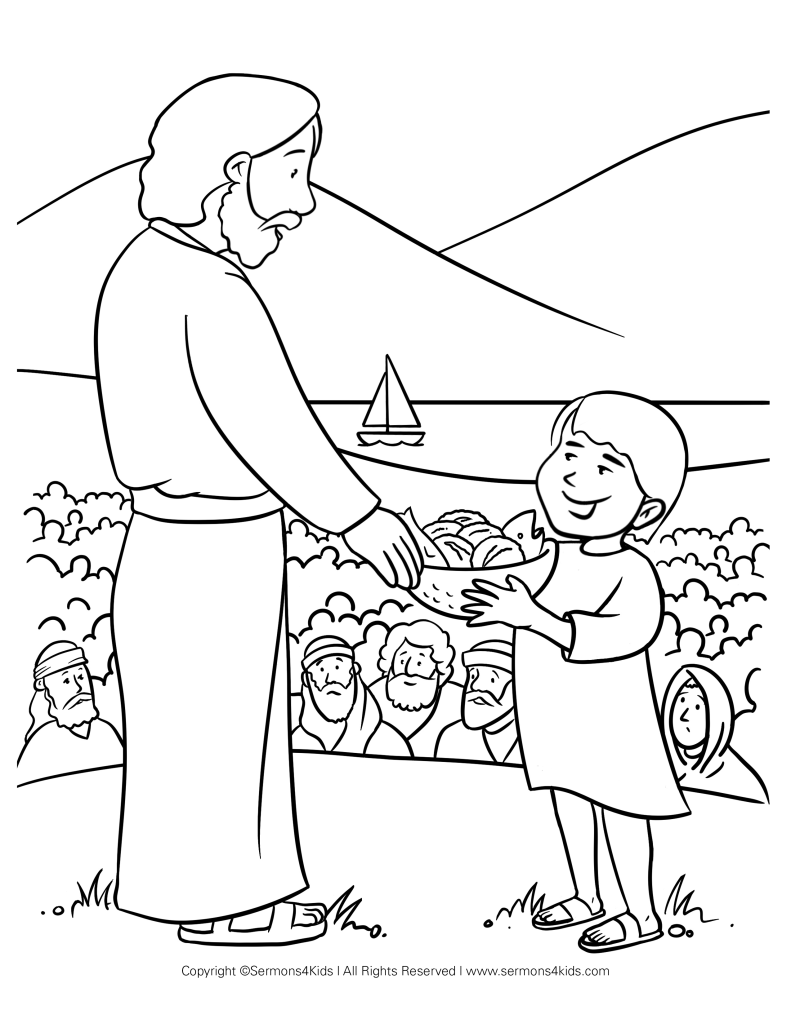
Andrew was another apostle. He had been asking people in the crowd if they had any food. He found one boy who had brought his lunch. The boy did not have much food. He only had two small fish and five small loaves of bread. Andrew did not know how this small amount would feed over five thousand people, but he took the food to Jesus anyway. He knew that Jesus could do anything!

Jesus said, “Divide all of the people into groups of fifty and tell them to sit down on the grass.” Soon the whole crowd was divided into small groups.

Then Jesus did a wonderful thing! He prayed to God to thank Him for the food and then he began handing bread and fish to people. Jesus began with only two fish and five loaves of bread but every time he handed it to someone, more bread and fish would appear. Jesus gave bread and fish to everyone in the whole crowd. Everyone ate bread and fish until they were full!

Finally, when everyone was finished, they cleaned up all of the small pieces of bread left over. The leftover bread was enough to fill twelve baskets full!

Jesus fed over five thousand people from two little fish and five small loaves of bread.  Jesus was powerful enough to take care of a whole crowd of people. Jesus is powerful enough to take care of you and me.