
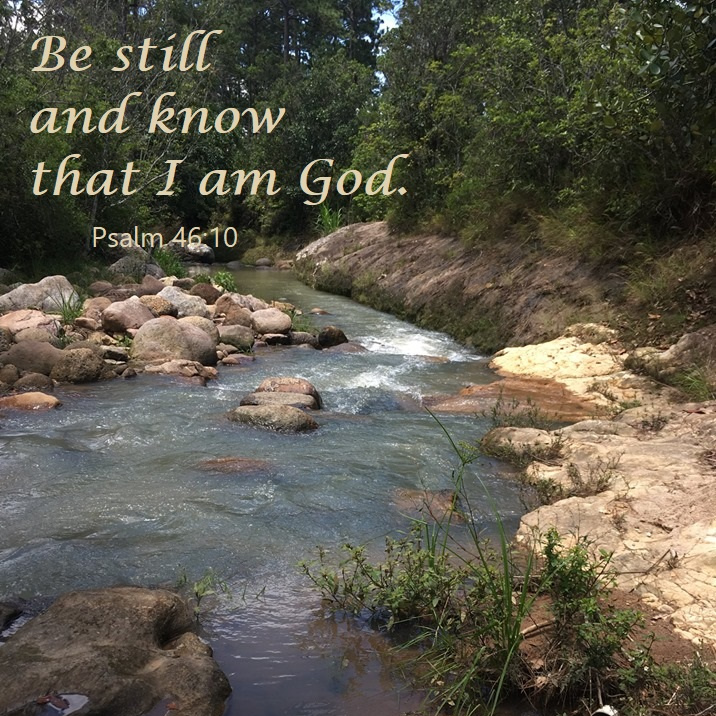
Be Still
Written by Dan
It has been my observation that David paints an amazing picture of how to approach God. He is specific; we are to have clean hands, a pure heart, and we are to focus on Him alone with no other distractions or adulations. When we do this, then our capacity to trust Jesus and hear his guidance is magnified. How does he speak? I think the one true living God speaks through two pillars — nature and revelation.
The universe was not created to be unmitigated disorder. Rather, the earth was created into the most proper shape and size for us by God’s infinite wisdom. God’s revelation, his logos in action, his truth in activities; is his wisdom personified and exemplified in the creation of all that we know.
Psalms 24: 1-6 says — The earth is the Lord’s, and everything in it, the world, and all who live in it; for he established it on the waters. Who may ascend the mountain of the Lord? Who may stand in his holy place? The one who has clean hands and a pure heart, who does not trust in an idol or swear by a false god. They will receive blessing [direction] from the Lord and vindication from God their Savior. Such is the generation of those who seek him, who seek [his] face, the God of Jacob (NIV).
When I think of this creation, built in the framework of God’s wisdom, I immediately become aware that he made nothing in vain. There is no waste, God intended everything I can see, feel, smell, touch or hear to achieve some endgame; it was designed to display his intention and grace for us. It should also be observed; we are created to reflect God’s goodness, we are not made in vain, we have purpose, we are created to serve his use and benefit, we are the perfect habitation for his Holy Spirit, and this is the cool part — all of this was planned for us before creation, long before anything was existent – he planned us.
Psalms 104: 19-32 (paraphrased) says – You made the moon to mark the seasons, and mark when the sun goes down. You bring darkness, it becomes night, and all the beasts of the forest prowl. … People go out to their work in the daylight; they labor until the evening moon rises. How many are your works. In wisdom you made them all; the earth is full of your creatures. All creatures look to you for their food at the proper time. When you give it to them, they gather it up; when you open your hand, they are satisfied with good things. When you hide your face, they are terrified; when you take away their breath, they die and return to the dust. May the glory of the Lord endure forever; may the Lord rejoice in his works—You look at the earth and it trembles; you touch the mountains and they smoke (NIV).
So, I wonder, how do we approach God? This is what I think – God reveals the path through the light of His creation and His revelation. The work of God’s creation overwhelmingly proves to me that He is the one true living God. This created beauty draws us into His presence. There is more. His revealed Word is absolute truth, the Word provides our guideposts, the Word draws us into his presence. We should note – God’s oracles (prophets) stomp all over any dribble eked out by soothsayers. Just look at the beauty and accuracy of any prophet in scripture. His message is profound and full of wisdom. The soothsayers produce vague platitudes for living, God’s prophets deliver deep pools of wisdom and foresight; their message is pure, considerate, impartial, and full of guidance for our life. (implied in James 4:17)
The soothsayers deliver their platitudes from dens and caverns with a soothing voice and ambiguous serene expressions; their message originates from dark vagueness as if the message is relevant. God delivered his message from the sunlight of Mount Sinai to all of us in distinct and intelligible logic – No darkness. Just Light, Love, and Holy Ground. Who do you think we can trust? Who has your best interest at heart? Do you want vague platitudes or focused instruction? Hmmm. I prefer God’s specificity.
I choose Jesus.
Written By Dan
It has been my observation while reading Psalm 115, our God reassures us that reconciliation and grace are always on the table, waiting for us to engage, waiting for us to yield. God made the earth we walk upon; he made all things on the earth for us. The earth was intended to be a cool place for us to live. It is unmistakably generated by God’s power, with his authority, and his immense wisdom. Yet, it pleases Him to make space for us to govern ourselves on earth and make use of his resources. His hand stretched out and created the heavens, he commanded all the hosts (angels) bringing them into existence, governing their activities and influence. All this is extremely good news for Israel, their God is creator and overseer of the universe.
Psalms 115: 1-11 says — Not to us Lord, not to us but to your name be the glory, because of your love and faithfulness. Why do the nations say, where is their God? Our God is in heaven; he does whatever pleases him. But their idols are silver and gold, made by human hands. They have mouths, but cannot speak, eyes, but cannot see. They have ears, but cannot hear, noses, but cannot smell. They have hands, but cannot feel, feet, but cannot walk, nor can they utter a sound with their throats. Those who make them will be like them, and so will all who trust in them. All you Israelites, trust in the Lord—he is their help and shield. House of Aaron, trust in the Lord—he is their help and shield. You who fear him, trust in the Lord—he is their help and shield. (NIV)
This is easy to ingest academically, but it is hard for me to wrap my mind around all this, to embrace it, and rely on it in everything we do or say. We are told in concrete language what God will do for us, that we might rest in his assurances, and build our life upon the notions of grace, redemption, and salvation. Let yourself think of this from God’s view. We are scheduled to last forever. Always around. Imagine one of your neighbors scheduled to be your neighbor forever. Always leaning in for more favors, wanting play time, wanting help in the yard, needing help to repair car troubles in the middle of the night, long endless talks. No relief – forever — 24/7 forever. Imagine a trillion of your closest neighbors always there forever. That is God’s perspective with a human flair. What an amazingly patient God we have. What human would design or plan this?
We have been given a remarkable gift. Liberty forever. This liberty has been proclaimed on the hilltops; God has put power into our hands. God has raised us up in righteousness, so that he may execute his promises through our hands. We are blessed.
What if I was an exiled Jew in Babylon; hoping (vaguely) for a return to a promised land I can barely remember. It seems like a hollow promise, never to be honored, but I say the words to stay out of trouble with my Jewish neighbors. I wait, wondering if the promise might be true. And then comes Cyrus. He closes in on my Babylon; we are anxious, not sure what will happen. Then it becomes clear. Cyrus captures the city and seems to be a reasonable person. Then Cyrus talks about sending the Jews home. Cyrus says he plans to facilitate the rebuilding of Jerusalem. How could I have planned that? Could this happen? The promise seemed like a bridge too far, but now things are changing. Who is this God? My Goodness. What is next?
Then I heard we are leaving for Jerusalem in a few days. We were captives, now we are a migrating nation, heading home. Home. How could this happen? Our bondage is over. God has redeemed us. He really did what he said he would do. Selah. Assuming the New Covenant and grace are part of your life, Elohim’s unmerited affection underscores a promise. The promise? We are heading home.
I choose Jesus.
Written By Dan
It has been my observation that all of us who trust in God can always have confidence in the one true living God. In Psalms 97 we find a God of power and dignity. A God that delivers his people from troubles. We find the author of our salvation. For me, I see a God who reached into my dismal shell of a life and renewed his grace within me. Let us take a look at the details.
Psalm 97:1-7 says — The Lord reigns, let the earth be glad; let the distant shores rejoice. Clouds and thick darkness surround him; righteousness and justice are the foundation of his throne. Fire goes before him and consumes his foes on every side. His lightning lights up the world; the earth sees and trembles. The mountains melt like wax before the Lord of all the earth. The heavens proclaim his righteousness, and all people see his glory. All who worship images are put to shame (NIV).
When I had nearly given up hope of ever being ‘in service of the King’ again, he reached out to me, a person whose life was the definition of a rebel. He called me back. There was no place for me to look for salvation except in the grace of Jesus, nothing else has any value. I tried. There was nothing. I looked in philosophy, I looked in history, I looked in science, I looked in Math, nothing. There is nothing else but Jesus. There is no other name on the face of the earth that can bring us hope. None.
For the Hebrew nation and for me Psalms 97 speaks about Jesus, the author of our salvation. Our salvation is assured by God’s power, it is treasured and delivered in God’s grace, it is guaranteed to be secure, permanent, authoritative. We are saved by his strong tower, we are enabled to run the race, we are permitted to take shelter in the tower, we are safe. If I look beyond this deliverance, from my life as a rebel to the deeper things of the Spirit, I quickly notice the messianic salvation, my everlasting ransom, the repair of my soul, my rescue from death. and the restoration of my walk in Jesus.
This I know for sure — there is a world without end; and it will be well or ill with us according to our willingness to embrace the Grace of God. Plato had a feeling for this ‘world that does not end,’ but he did not find an answer to the question – is it real? Plato died when Alexander the Great was a child, Alexander the Great conquered Israel on his way south to conquer Egypt and build the city of Alexandria, soon the libraries he established became the global home of most knowledge known to man.
There are many historians that think the Septuagint (Greek Old Testament) was retained in the Alexandrian library. Why does this matter? Because this library was a repository of known knowledge. This library would have provided an answer to Plato’s question, he was curious, but he died before the library was completed. Do not wait – God’s word is readily available. Read. Now. Not tomorrow. Now.
All of us, including me, know of the confusion we felt when we first became aware of our sin and the impact of that sin (before we knew Jesus). We felt trapped, unable to escape the effect, unable to bring ourselves to accept Jesus. We ran to and frow, looking for anyone with answers that could override Grace. We tried to build community in our sin and tell ourselves it was not sin; we became forward thinking people abandoning the age-old truths. We puffed up our little heads and glared at the one true living God. Defiant, we refused to submit. We joined hands with other rebels and resisted the gospel. We kept one another’s countenance as bright as possible and wandered in confusion together. Then it happened. The light of truth outran the darkness in our heart. In the light we saw we had no clothes on. We were standing in sin. No protection. The light exposed everything. Darkness can only be overcome by one thing – the way, the truth, and the light. Selah. We yield. I thank God he chose to pursue me.
I choose Jesus.
Written By Dan
It has been my observation that when the Bible speaks on a topic, the Bible speaks absolute truth. Furthermore, I find no path available (within the confines of absolute truth) to yield on this point and remain faithful to scripture (God’s message). But sometimes, we observe that scripture leaves gaps in the information presented.
What do we do? What should we do? The focus of this essay is one of those gaps. Let us explore the duration (timeline) for the troubles of Job. Scripture does not comment on the complete timeline, but I have attempted to form a reasonable estimate of the timeline drawing from available scripture and a close reading of a map. I chose this subject because it does not present the same struggles that other gaps in scripture do.
Let us start at the beginning. Job was a real person who experienced the real events described in the book of Job. I start with that truth. I believe his friends (Eliphaz, Bildad, and Zophar) were earnest but misguided – they were scolded by God at the end of the account (see Job 42:7-9). I believe that Elihu was on point – he was not scolded by God at the end of the account. But it remains, how much time did the story traverse?
The following dialogue is ‘one man’s opinion’ — a safe way to demonstrate how to deal with an unknown. I am not recommending that you build life theology on my findings, rather I traveled this path to try to wrap my mind around the message of Job and to form an understanding for the duration of his woes. 30 years, 3 years, 3 weeks, 3 days, 3 minutes – these various spans of time all affect the intensity of the account.
We know that Job’s suffering began with the death of his servants and the loss of his livestock. Then his troubles became progressively worse with the deaths of his 10 children and his physical afflictions. We are told that four messengers came, one after the other while the previous one “was yet speaking…” (Job 1:13-19). Scripture says this encounter with the four messengers happened in a single day (Job 1:13).
I think Lucifer would strive to create the maximum amount of chaos in Job’s life (within the limits place upon Lucifer by God) to create the maximum impact on Job. This seems intense but we know God does not permit trouble we cannot endure as long as we lean on God (implied in Psalms 37:24, 1 Corinthians 10:13).
In Job chapter 1:13-19 we read — One day when Job’s sons and daughters were feasting and drinking wine at the oldest brother’s house, a messenger came to Job and said, “The oxen were plowing and the donkeys were grazing nearby, and the Sabeans attacked and made off with them. They put the servants to the sword, and I am the only one who has escaped to tell you!” While he was still speaking, another messenger came and said, “The fire of God fell from the heavens and burned up the sheep and the servants, and I am the only one who has escaped to tell you!” While he was still speaking, another messenger came and said, “The Chaldeans formed three raiding parties and swept down on your camels and made off with them. They put the servants to the sword, and I am the only one who has escaped to tell you!” While he was still speaking, yet another messenger came and said, “Your sons and daughters were feasting and drinking wine at the oldest brother’s house, when suddenly a mighty wind swept in from the desert and struck the four corners of the house. It collapsed on them and they are dead, and I am the only one who has escaped to tell you!” (NIV)
What a mess. Then a conversation happens between God and Lucifer. This happens while Job is recovering from the troubles. His wife comments on the troubles. (see Job 2). Again, these conversations take about a day. We are prudent to allow time between each key day.
Next, we are told that three of Job’s friends (Eliphaz, Bildad, and Zophar) decided to visit him when they heard of his suffering (implied in Job 2:11). We know the name of the places they come from; but we are unsure where the places are located on a map. What do we know about this situation? Numbers 1:2 suggests it takes about 11 days to travel from Egypt to the promised land. I choose to assume Job’s friends lived closer than Egypt. Friends tend to live near each other. I suspect they arrive at Job’s place within 10 days of the initial event (three days to get the notification, four days to prepare, and three days to travel). This assumption suggests a maximum of about 2 weeks from notification to arrival (why? Because they lived close to him).
We know Job’s three friends sat with Job in silence for 7 days. Then his friends conducted a debate with Job containing 9 discourses (see Job 3-27). After Job’s three friends ceased debating, Job speaks on a deeper level (Job 28-31). Finally, Elihu, a young man, arrived and spoke up (see Job 32-37). When Elihu ceased speaking, then God spoke. God first asked questions of Job (Job 38-41), and then He rebuked Job’s three friends. Overall, I estimate about 3-4 weeks for the debate (1 week of silence, 2-3 weeks of debate).
Given the first few days of notifications from the four messengers, the conversation with his wife, the notification and travel time for Eliphaz, Bildad, and Zophar, and the debate, we find ourselves with about 6-8 weeks of time.
Let us pause to notice how Job responded to the Lord (Job 42:2-6) “I know that You can do everything, … You asked, ‘Who … hides counsel without knowledge?’ Therefore, I have uttered what I did not understand, Things too wonderful for me, which I did not know. … I have heard of You by the hearing of the ear, but now my eye sees You. Therefore, I abhor myself, and repent in dust and ashes. “
After the three friends left (implied in Job 42:9), God restored Job (implied in Job 42:10). Based on this analysis I suggest the timeline for the troubles of Job and the assorted conversations traversed a couple of months. I prefer to think the restoration (see Job 42) happened over a few years. The Bible simply does not say. But it helps me to understand the flow of events if I place the occurrences for most of the Book of Job into a window of a few months. You may hold a different opinion — I’m good with that. I do not think it would be fruitful to debate this topic much. I formed this opinion as a tool, a framework, to help me visualize the events unfolding as described in the book of Job.
The deeper truth from Job — When God allows us to suffer in any way, or for any length of time, we must remember that He has a purpose (implied in Romans 5:3-5). The absence of a timeline in the Book of Job helps us to avoid comparing the duration of our suffering to Job’s suffering. We are promised God will work all things for our ultimate good and His glory (implied in 1 Corinthians 10:13). Therefore, what matters most is not the length of suffering, or even the severity of our suffering, it is how we choose to embrace the suffering (implied in Ecclesiastes 5:1-7). Where do we turn for comfort and hope? When we turn to God in faith, our hearts change, and troubles eventually evaporate (implied in James 1:2-4). Then the desired effect of the unknown timeline may produce the outcome God intended (see Psalms 46:10).
I choose Jesus.
Written By Dan
It has been my observation that we Christians look to the Bible for lasting meaning and hope; this search allows us to use our reasoning abilities as God intended. The Bible presents the reality of God (implied in Revelation 1:8), who has revealed Himself to all people (implied in Psalms 19:1-2).
The apostle Paul argued this point when he wrote, “since the creation of the world His invisible attributes, eternal power, and divine nature have been clearly seen; being understood through what has been made, so that they are without excuse” (Romans 1:20). This declaration, in which God reveals Himself through nature, is also shown to the heart of every person, for “that which is known about God is evident within them; for God made it evident to them” (Romans 1:19).
John Calvin referred to this as the ‘sensus divinitatis’, which is an innate sense of divinity, an intuitive knowledge that God exists. Calvin wrote, “there exists in the human mind and indeed by natural instinct, some sense of Deity.” He further states, “All men of sound judgment will therefore hold, that a sense of Deity is indelibly engraved on the human heart.” Calvin also wrote, “there never has been, from the very first, any corner of the globe, any city, any household, without religion, [which] amounts to a tacit confession, that a sense of Deity is inscribed on every heart.”
The problem is not with God’s clear revelation, but with the human heart which is rebellious. For those possessed with sinful persistence, they suppress the truth with their unrighteousness (implied in Romans 1:18). These rebels have a sinful heart that ignores God’s grace to pursue earthly passions.
In Romans 1:21-23 Paul wrote — For although they knew God, they neither glorified him as God nor gave thanks to him, but their thinking became futile, and their foolish hearts were darkened. Although they claimed to be wise, they became fools and exchanged the glory of the immortal God for images made to look like a mortal human being and birds and animals and reptiles. (NIV).
God never forces Himself on anyone. People are free to choose whether to accept Him or not. If they reject the gentle nudge from the Spirit of God, he does not render the final judgment upon them right away. Rather, God extends to them an undeserved period of kindness and goodness, regardless of whether they have yielded to grace or continue rebelling (implied in John 3:16). But death brings the period of kindness to closure.
This grace is dependent on God and not the attitude or actions of men. Jesus said of His Father, that “He causes His sun to rise on the evil and the good and sends rain on the righteous and the unrighteous” (Matthew 5:45). Paul affirmed this grace, saying, “In the generations gone by, He permitted all the nations to go their own ways [in rebellion]; and yet He did not leave Himself without witness, in that He did good and gave you rains from heaven and fruitful seasons, satisfying your hearts with food and gladness” (Acts 14:16-17). Here, God’s grace is obvious, Elohim provides what we need. He even blesses the unsaved and unrepentant. His love, mercy, and goodness are extended toward the undeserving entirely because of his earnest goal to see all of us yield to Grace before we die.
Salvation comes to us by grace alone (it is an undeserved gift), through faith alone (adding no works), by Jesus alone (as the only One who saves). Paul wrote, “For by grace you have been saved through faith; and that is not of yourselves, it is the gift of God; not as a result of works, so that no one may boast” (Ephesians 2:8-9). Salvation comes to us via the death, burial, and resurrection of Jesus (implied in Romans 10:9). We deserve death; but grace abounds through the ransom paid by the Lamb of God.
I choose Jesus.
3-11 So don’t return us to mud, saying,
“Back to where you came from!”
Patience! You’ve got all the time in the world—whether
a thousand years or a day, it’s all the same to you.
Are we no more to you than a wispy dream,
no more than a blade of grass
That springs up gloriously with the rising sun
and is cut down without a second thought?
Your anger is far and away too much for us;
we’re at the end of our rope.
You keep track of all our sins; every misdeed
since we were children is entered in your books.
All we can remember is that frown on your face.
Is that all we’re ever going to get?
We live for seventy years or so
(with luck we might make it to eighty),
And what do we have to show for it? Trouble.
Toil and trouble and a marker in the graveyard.
Who can make sense of such rage,
such anger against the very ones who fear you?
12-17 Oh! Teach us to live well!
Teach us to live wisely and well!
Come back, God—how long do we have to wait?—
and treat your servants with kindness for a change.
Surprise us with love at daybreak;
then we’ll skip and dance all the day long.
Make up for the bad times with some good times;
we’ve seen enough evil to last a lifetime.
Let your servants see what you’re best at—
the ways you rule and bless your children.
And let the loveliness of our Lord, our God, rest on us,
confirming the work that we do.
Oh, yes. Affirm the work that we do!

 Shalom Talk