
Daniel and the Lion’s Den

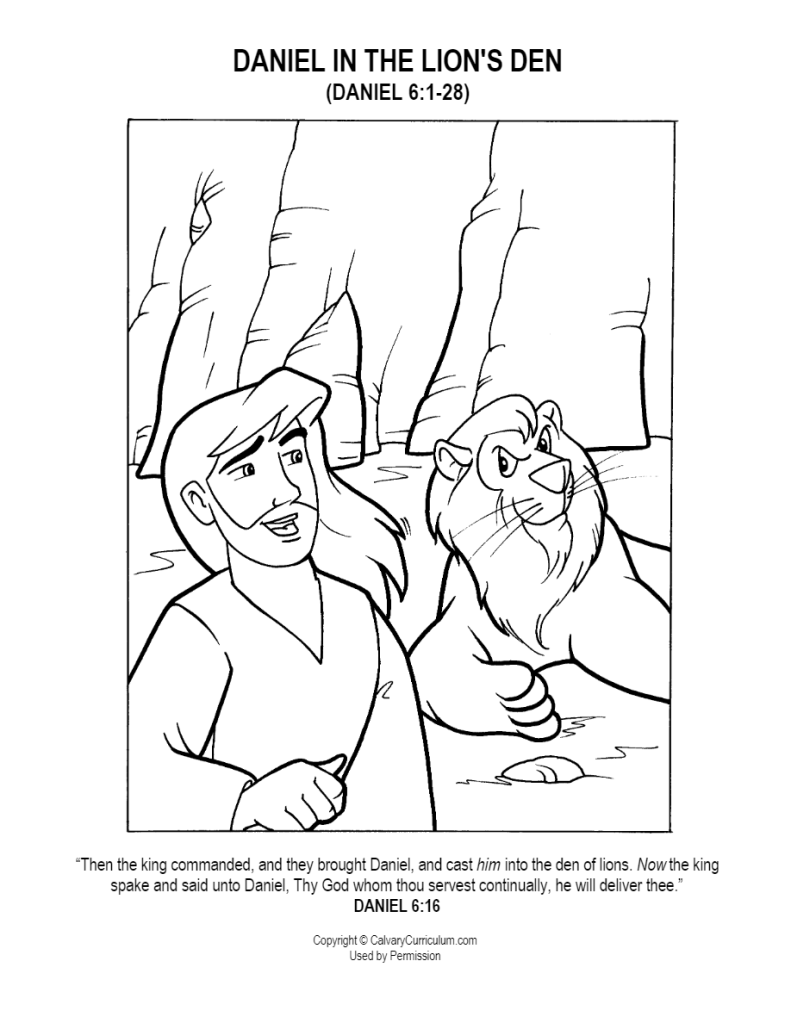
Once upon a time, there lived a young man named Daniel. He was a kind and brave man who loved his friends, family, and most importantly, he loved God. Daniel always prayed to God every day and followed His commandments.  At that time, Daniel lived in a big kingdom ruled by a powerful king called Darius. 

King Darius really liked Daniel because he was wise, honest, and very good at his job. The king decided to make Daniel one of his most trusted advisors, which made some of his other advisors very jealous. These advisors plotted to get rid of Daniel. They tricked the king into making a law which said that nobody could pray to any god or person except the king for 30 days.  Anyone who disobeyed this law would be thrown into a den filled with hungry lions.

Even though Daniel knew about the new law, he still prayed to God three times a day, just as he always did. When the wicked advisors found out, they ran to the king and told him that Daniel was breaking the law. When the king found out, he was extremely upset because he realized he had no choice but to punish Daniel. Although he liked Daniel, he had to follow the law.  King Darius reluctantly ordered Daniel to be thrown into a den filled with hungry lions. The king hoped that God would save Daniel because he knew how faithful Daniel was.

King Darius was so worried about Daniel, he was unable to sleep that night. Early the next morning, he rushed down to the den to see if Daniel was still alive. The king called out to him and was overjoyed when Daniel replied. Daniel explained that God had sent an angel during the night to protect him, and that he was unharmed. King Darius was delighted. The king then declared that from that day on everyone in his kingdom should worship Daniel’s God, the one true God.

Meanwhile, the jealous advisors were all punished for their wicked deeds. The king had them thrown into the lions’ den, and they were pounced upon immediately.  Daniel continued to be faithful to God all his life. He became a wise advisor to King Darius and helped make the kingdom a better place. People throughout the kingdom admired him for his bravery and his strong faith in God.
1 Timothy 2

Simple Faith and Plain Truth

1-3 The first thing I want you to do is pray. Pray every way you know how, for everyone you know. Pray especially for rulers and their governments to rule well so we can be quietly about our business of living simply, in humble contemplation. This is the way our Savior God wants us to live.

4-7 He wants not only us but everyone saved, you know, everyone to get to know the truth we’ve learned: that there’s one God and only one, and one Priest-Mediator between God and us—Jesus, who offered himself in exchange for everyone held captive by sin, to set them all free. Eventually the news is going to get out. This and this only has been my appointed work: getting this news to those who have never heard of God, and explaining how it works by simple faith and plain truth.

8-10 Since prayer is at the bottom of all this, what I want mostly is for men to pray—not shaking angry fists at enemies but raising holy hands to God. And I want women to get in there with the men in humility before God, not primping before a mirror or chasing the latest fashions but doing something beautiful for God and becoming beautiful doing it.

11-15 I don’t let women take over and tell the men what to do. They should study to be quiet and obedient along with everyone else. Adam was made first, then Eve; woman was deceived first—our pioneer in sin!—with Adam right on her heels. On the other hand, her childbearing brought about salvation, reversing Eve. But this salvation only comes to those who continue in faith, love, and holiness, gathering it all into maturity. You can depend on this.

A Drop of Water

Essay By Dan

It has been my observation that exploring God’s Wisdom tends to be accomplished by those of us who are hanging out in God’s sandbox (life in the Spirit), already yielding to the God we serve. The unbelieving mind struggles to be convinced by any proof on topics that include the wisdom of God, but those of us who play in the sandbox, walk with God, talk to God, listen to God, we need no proof. We know. We are hungry to know more.

Permit me to share some paraphrased thoughts from Blaze Pascal (a 16th century Mathematician and namesake for a programming language) about wisdom: We should expect neither truth nor consolation when men act on their own. God formed man and alone taught each of us what we are. God created man to be innocent; God filled man with light and intelligence; God communicated to him wisdom, glory, and awareness of God’s wonders. Through wisdom, the eye of man saw the majesty of God. But man has not been able to sustain the glory God gave him without falling into pride. Man wanted to make himself his own center and free himself from God’s wisdom; therefore, man withdrew himself from God’s grace; then ignored God’s wisdom and set himself equal to God.

Daniel said – Praise the name of God for ever and ever; wisdom and power are his. He changes times and seasons; he deposes kings and raises others up. He gives wisdom to the wise and knowledge to the discerning (paraphrased from Daniel 2:20-21).

When our feeble scribblings about God declare that God is wise, the meaning is far more powerful than what we could ever possibly place on paper. We work to make a comparatively overused word represent the incomprehensible depth of God’s cohesive analytical processing algorithms and breadth of knowledge. Unfortunately, in my weakness, even in this case I have diminished the one true living God’s absolute greatness and majesty merely by my choice of words. On my best day I will fail. Bummer. Isaiah 40:28 says “The Lord is the everlasting God, the Creator of the ends of the earth. He does not faint or grow weary; His understanding is unsearchable.”

His wisdom is infinite (see Psalms 147:5). We know the word infinite describes the bandwidth, height, and depth of something. Given this is the maximum term we could use, we cannot very well put an adjective to enhance the meaning of the word. Would it be appropriate to say “more” infinite or “very” infinite? I think not. Infinite is the correct word. God sets the standard on infinite Wisdom. When I first learned Pascal (a programming language) the notion of MAXINT (the maximum integer possible) seemed immense. However, in the context of God’s wisdom, MAXINT seems like a naive vision of the world (see Proverbs 14:18).

I believe wisdom is taught to us by the Spirit of God (see Nehemiah 9:20) so that on our best day we have the capacity to yield to God’s wisdom as we address situations in a meaningful, positive, moral way. But we should never lose sight that God is infinitely wise and our use of God’s wisdom is but a slight shadow of the totality of God’s wisdom. Our understanding of God’s wisdom is like a drop of water that takes its place in the ocean of water (God’s wisdom) covering most of this globe.

Paul says – “Oh, the depth of the riches of the wisdom and knowledge of God! How unsearchable his judgments, and his paths beyond tracing out! Who has known the mind of the Lord? Or who has been his counselor?” (Romans 11:33-34). There will be much more on this topic of playtime in sandboxes – a lot more from Job, Ecclesiastes, Proverbs, and Lamentations.

I choose Jesus.